Australia Student Visa Assessment Level 3 for Nepalese Students: Guide to Study in Australia

Nepal is currently classified under Australia Student Visa Assessment Level 3, making the visa process more strict, transparent, and documentation-focused for Nepali students. If you are planning to study in Australia from Nepal, understanding Assessment Level 3 requirements is no longer optional-it is essential.

Under this assessment level, Australian immigration officers closely evaluate academic strength, course relevance, financial clarity, English proficiency, and genuine student intent. Shortcuts such as low-ranked colleges, weak profiles, manipulated documents, or copy-paste SOPs significantly increase the risk of visa refusal.

This complete guide explains everything Nepali students must know about Australia Student Visa Assessment Level 3, along with expert insights on why choosing the best education consultancy in Nepal is critical for safe and successful visa approval.

What Is Australia Student Visa Assessment Level 3?

Australia Student Visa Assessment Level 3 means applications from Nepal are considered high-risk and receive maximum scrutiny from the Department of Home Affairs. Your application is assessed as a complete profile-not as separate documents.

Key factors assessed include:

  • Academic background
  • Course relevance
  • English language proficiency
  • Financial capacity and source of funds
  • Genuine Student (GS) statement
  • Health and character requirements

Even if one area is weak, your visa can be refused despite strengths in other sections. Under Assessment Level 3, balance and consistency matter more than anything.

Why Precision and Honesty Matter More Than Ever

For students planning to study in Australia from Nepal, honesty is the foundation of visa success. Australian immigration now uses advanced verification systems, making fake or manipulated documents easy to detect.

High-risk practices that lead to refusal:

  • Choosing low-compliance or non-genuine colleges
  • Random course changes unrelated to past studies
  • Short or unclear bank history
  • Unexplained source of funds
  • Copy-pasted or AI-generated SOPs

Academic Requirements for Assessment Level 3

Academic strength plays a major role in visa decisions.

Minimum Academic Criteria

For Bachelor’s or Master’s programs:

  • Minimum 60% overall or GPA 2.8+ is considered safe

If your academic score is low, your profile must be supported by:

  • Strong IELTS or PTE score
  • Relevant work experience
  • A clear and logical GS statement

Weak academics without justification significantly increase refusal risk.

Study Gap Rules for Nepalese Students

Study gaps are closely examined under Assessment Level 3.

Important rules:

  • Gaps must be clearly justified with logic
  • Working gaps must include:
    • Salary credited in bank account
    • Tax paid evidence
    • Experience letters

Any gap longer than six months without proper documentation is considered high risk. Unexplained gaps are one of the most common reasons for Australia student visa refusal.

Course Relevance: The Most Critical Factor

Course relevance is often the deciding factor for students applying under Assessment Level 3.

Your selected course must:

  • Be logically connected to your previous study background in Nepal
  • Support clear career progression
  • Match your academic background and experience

Random course changes-such as management to IT or science to hospitality without strong justification-raise serious doubts about genuine student intent.

Australian immigration prioritizes career-oriented education, not PR-driven or shortcut-based decisions.

English Language Requirements (IELTS / PTE)

English requirements are stricter for Level 3 countries like Nepal.

Bachelor Level

  • IELTS: Overall 6.0 (no band less than 5.5), depending on the course, such as Bachelor’s of Nursing, BSW requires 7/7
  • PTE: Overall 50 (no band less than 42)

Master Level

  • IELTS: Overall 6.5 (no band less than 6.0) | MSW: 7/7 | Master of Teaching: 7.5/7
  • PTE: Overall 58 (no band less than 50)

Direct entry with strong English scores is safer. ELICOS or package courses carry higher visa risk under Assessment Level 3.

Financial Requirements for Australia Student Visa

Financial verification is extremely strict under Assessment Level 3.

Required Funds (1 Year)

  • Living cost: AUD 29,710
  • Tuition fee: AUD 22,000-40,000 (depending on course)
  • Travel cost: Approx. AUD 2,000

Bank and Income Rules

  • Bank statement should be at least 12 months
  • Source of funds must be clearly explained with statement
  • Annual income should be at least NPR 22-25 lakhs (tax paid)

For job or business income:

  • Tax clearance certificates
  • PAN and company documents are mandatory

Education loans are accepted only from A-class banks. Clean funding with a clear source significantly strengthens your visa profile.

Genuine Student (GS) Requirement Explained

The former GTE has been replaced by the Genuine Student (GS) requirement.

Your GS statement must clearly explain:

  • Why you chose Australia over other countries like Canada, New Zealand or UK
  • Why you selected a specific university (not cheap colleges)
  • How the course aligns with your academic and career background
  • Your future plan after graduation, including:
    • Intended job role in Nepal
    • Industry
    • Expected salary

A weak or generic GS statement can lead to refusal even if academics and finances are strong.

Health and Character Requirements

All applicants must meet Australia’s health and character standards:

  • Overseas Student Health Cover (OSHC) is compulsory
  • Police Clearance Certificate must be clean
  • Medical examination must be passed

Your SOP or GS must be self-written, genuine, and logical. Copy-paste or AI-generated content is easily identified.

Expert Tips to Study in Australia from Nepal (Assessment Level 3)

  • Choose universities over low-compliance private colleges
  • Select career-focused courses, not PR-oriented ones
  • Prefer regional locations like Adelaide, Perth, Hobart, Darwin
  • Avoid institutions with poor compliance history
  • Be interview-ready
  • Apply strategically, not emotionally

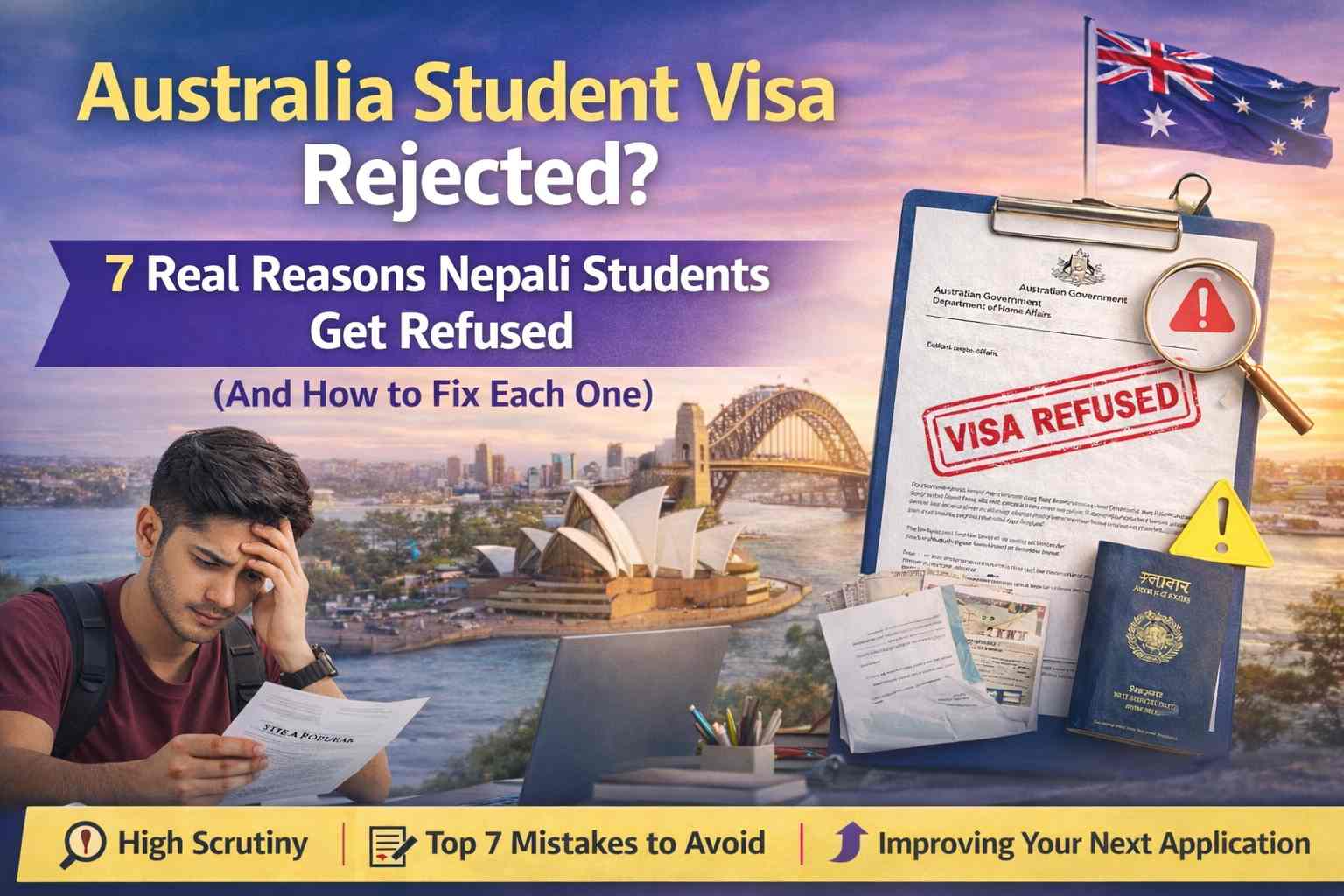
Common Reasons for Australia Student Visa Refusal

  • Fake or altered documents
  • Weak English scores
  • Course mismatch
  • Short or unexplained bank history
  • Low or unclear income source
  • Poor GS or SOP
  • Selection of non-genuine colleges

Why Education Tree Global Is the Best Education Consultancy in Nepal

Applying under Assessment Level 3 requires experience, accuracy, and ethical guidance. Education Tree Global is trusted by students who want to study in Australia safely and successfully.

What Education Tree Global offers:

  • Profile-based counseling
  • Honest assessment with no false promises
  • Strong university partnerships
  • Clean and compliant documentation support
  • Career-oriented course guidance

For students searching for the best education consultancy in Nepal, the right guidance can make the difference between approval and refusal.

Conclusion

To successfully study in Australia from Nepal under Assessment Level 3, students must focus on strong academics, relevant courses, clean finances, and genuine student intent. Shortcuts no longer work-but proper planning does.

If you want transparent guidance and a higher chance of visa success, Education Tree Global is ready to support you at every step of your journey to Australia.

FAQs: Australia Student Visa Assessment Level 3 for Nepalese Students

1. What does Assessment Level 3 mean for Nepalese student visa applications?

Assessment Level 3 is the highest risk category under Australia’s Simplified Student Visa Framework (SSVF), meaning applicants from Nepal must submit more detailed and verifiable documents – especially financial evidence, academic records, English proficiency, and a strong Genuine Student (GS) statement – because applications are assessed with maximum scrutiny.

2. How has Nepal’s assessment level recently changed for student visas?

Australia’s Department of Home Affairs updated its evidence level framework in January 2026, moving Nepal (along with India, Bangladesh, and Bhutan) to Evidence Level 3, which increases documentation requirements and thorough checks to manage immigration risk and verify application integrity.

3. Does Assessment Level 3 mean that Nepalese students will be refused more often?

Not necessarily – but because Level 3 requires comprehensive documents and genuine, logical explanations, applications with missing details (e.g., unexplained study gaps or weak source‑of‑fund evidence) are more likely to be refused. Preparing a balanced and compliant profile is crucial for success.

4. Are English test scores mandatory under Assessment Level 3?

Yes – under high‑risk assessment, valid English language test results (IELTS, PTE, or equivalent) are strongly required. Even if a university accepts your score, the Department of Home Affairs may still request it as part of the visa decision. Ensure your test results are current and meet both the university and visa requirements.

5. What is the Genuine Student (GS) requirement and how does it affect my visa?

The Genuine Student (GS) requirement replaces the old GTE test and assesses whether you genuinely intend to study in Australia, how your chosen course fits your academic/career path, and whether you plan to return home after graduation. A weak, generic, or AI‑generated GS statement significantly increases refusal risk under Level 3 scrutiny.

ETG Edu Fair 2026: The Most Valuable Study Abroad Event of the Year

Choosing the right country, university, and course is one of the most life-changing decisions for students planning to study abroad. With countless options, changing visa rules, and overwhelming online information, the journey can easily become confusing and stressful.

This is exactly why ETG Edu Fair 2026 matters.

Organized by Education Tree Global, the best education consultancy in Nepal, ETG Edu Fair 2026 is designed to be the most valuable, trusted, and student-focused education event of the year-bringing expert guidance, global opportunities, and real clarity under one roof.

What Is ETG Edu Fair 2026?

ETG Edu Fair 2026 is a premium education fair in Nepal created to help students confidently plan their international education journey. It offers direct access to expert counselling, global study destinations, and exclusive student benefits that are rarely available in one place.

This flagship study abroad fair focuses on the world’s most popular destinations-Australia, the UK, the USA, Canada, New Zealand, and Europe-making it the ideal event for students planning to study in 2026 and beyond.

Event Dates and Locations

Kathmandu

Date: Tuesday, 20th January 2026
Venue: Opposite City Centre, Kamalpokhari, 5th Floor

Chitwan

Date: Saturday, 24th January 2026
Venue: Lions Chowk, KL Mall, 5th Floor

Students can attend the event at the location most convenient to them and receive the same high-quality guidance.

Register Now

Why Education Fairs Are Important for Students

Education fairs play a critical role in helping students make informed decisions. Instead of spending months navigating confusing online information, a study abroad fair in Nepal provides trusted answers instantly.

By attending ETG Edu Fair 2026, students can:

  • Understand country-specific admission and visa requirements
  • Compare multiple study destinations in one visit
  • Receive personalised academic and career guidance
  • Avoid misinformation and costly mistakes

For beginners especially, education fairs transform a complex process into a clear, practical, and confident journey.

What Students Will Get at ETG Edu Fair 2026

ETG Edu Fair 2026 is carefully designed to deliver real value, not just information.

Free Application and Admission Processing

Students receive professional guidance on applications with no processing charges, helping significantly reduce study-abroad expenses.

One-to-One Academic Counselling

Experienced counsellors provide personalised advice based on academic background, career goals, and preferred destination.

Free Profile Assessment

Students receive a detailed evaluation of their academic profile to understand eligibility, admission chances, and the most suitable courses.

Financial Counselling

Clear and practical guidance on tuition fees, living costs, financial planning, and funding options is provided.

IELTS and PTE Support (Up to 80% OFF)

Students planning English proficiency tests can access highly discounted IELTS and PTE preparation services.

Study Destinations Covered at ETG Edu Fair 2026

ETG Edu Fair 2026 allows students to explore multiple top global study destinations in one place, explained in a clear, honest, and practical way by expert counsellors.

Study in Australia

Australia remains one of the most preferred destinations due to its world-class education and strong post-study work options. Students will learn about:

  • Popular courses such as IT, Business, Health, and Engineering
  • Post-study work visas and employment opportunities
  • Tuition fees, scholarships, and living costs
  • Student lifestyle and part-time work options

Study in United Kingdom (UK)

Known for globally respected degrees and shorter course durations, the UK attracts ambitious students. Guidance includes:

  • Undergraduate and postgraduate programs
  • One-year master’s degree advantages
  • Entry requirements and visa processes
  • Career prospects after graduation

Study in United States (USA)

The USA offers unmatched academic diversity and research opportunities. At the fair, students can explore:

  • Flexible education systems and course choices
  • Community colleges and university pathways
  • Scholarship and funding opportunities
  • Campus life and academic support services

Study in Canada

Canada is highly valued for its welcoming environment and immigration opportunities. Students receive information on:

  • Affordable education and quality institutions
  • Post-Graduation Work Permits (PGWP)
  • Permanent residency pathways
  • Safe and multicultural student life

Study in New Zealand

New Zealand offers a perfect balance of quality education and lifestyle. Students will learn about:

  • Internationally recognized qualifications
  • Research-based learning approaches
  • Work rights during and after studies
  • Living standards and student support

Study in Europe

Europe provides diverse and affordable education options across multiple countries. At the fair, students can explore:

  • Low-cost or tuition-free education options
  • English-taught programs across Europe
  • Cultural diversity and global exposure
  • Career opportunities within European countries

Each destination is explained by experienced counsellors from the best education consultancy in Nepal, ensuring accurate, updated, and trustworthy guidance.

Special Offer for Early Attendees

To make ETG Edu Fair 2026 even more rewarding, free movie tickets will be provided to the first 50 attendees who bring:

  • Academic documents
  • English proficiency certificates (if available)

This special offer encourages students to come prepared and make the most of their counselling sessions.

Who Should Attend ETG Edu Fair 2026?

This event is ideal for:

  • +2 graduates planning undergraduate studies
  • Bachelor’s graduates planning postgraduate studies
  • Students preparing for IELTS or PTE
  • Parents seeking trusted guidance for their children
  • Anyone planning to study abroad in the near future

No prior experience or knowledge about studying abroad is required.

Why Choose Education Tree Global?

Education Tree Global is widely recognized as the best education consultancy in Nepal for its transparency, expertise, and student-first approach.

Students trust Education Tree Global for:

  • Reliable and up-to-date information
  • Ethical and honest counselling practices
  • End-to-end study abroad support
  • Strong expertise in visa and admission processes

ETG Edu Fair 2026 reflects the same commitment to quality, clarity, and student success.

Conclusion

ETG Edu Fair 2026 stands out as the most valuable education event of the year for students planning to study abroad. Organized by Education Tree Global, this education fair offers trusted guidance, global opportunities, and expert support to help students plan their future with confidence.

Attending this fair can save time, reduce confusion, and lead to smarter academic decisions, making it a must-attend event for anyone serious about international education.

FAQs – ETG Edu Fair 2026

  • Is ETG Edu Fair 2026 free to attend?
    Yes, the education fair is completely free for all students.

  • Which countries are covered at the ETG Edu Fair 2026?
    Australia, the UK, the USA, Canada, New Zealand, and Europe.

  • What documents should be brought to the Edu Fair?
    Academic documents and English proficiency certificates (if available) are recommended.

  • Will free counselling be available?
    Yes, students will receive free one-to-one counselling and profile assessment.

  • Who is organizing ETG Edu Fair 2026?
    The fair is organized by Education Tree Global, recognized as the best education consultancy in Nepal.

10 Cheapest US Universities for Nepalese Students: 2025 Review

Choosing to study in the USA is a massive financial commitment for any Nepalese family. With over 15,000 Nepalese students currently pursuing degrees there, the demand is high, but so are the costs. Most families aim for a “sweet spot” budget of USD 15,000–25,000 per year (NPR 20–33 Lakhs).

However, finding a university that fits this budget and has a supportive community is tough. This guide cuts through the noise. We have verified the 2025-2026 costs for 10 specific universities that are truly affordable. Whether you need low tuition, high acceptance rates, or a specific STEM program, this list uses real data to help you make the right choice.

10 Affordable Universities in USA: 2025 Cost Breakdown (NPR)

This table gives you a quick snapshot of the annual costs (Tuition + Living) and your chances of getting in.

Rank University Location Annual Cost (NPR) Acceptance Rate Merit Scholarships
1 Eastern New Mexico University Portales, NM 19.38 L 75% USD 5-10K
2 Chadron State College Chadron, NE 18.32 L 95% USD 4-8K
3 Valley City State University Valley City, ND 21.01 L 82% USD 3.5-7.5K
4 Dickinson State University Dickinson, ND 21.28 L 85% USD 4-8K
5 Minot State University Minot, ND 21.71 L 77% USD 3-8K
6 Bemidji State University Bemidji, MN 27.14 L 75% USD 5-12K
7 Arkansas State University Jonesboro, AR 22.91 L 80% USD 3-10K
8 Alcorn State University Lorman, MS 22.59 L 98% USD 3-18K
9 Univ. of Central Arkansas Conway, AR 23.70 L 85% USD 4-9K
10 University of Wyoming Laramie, WY 28.87 L 75% USD 4-7.5K

ETG Expert Tip: The “Annual Cost” listed above is critical. This is roughly the amount you need to show in your Bank Balance Certificate (from a Class A Bank) to receive your I-20 form.

10 Cheapest Universities in USA for International Students: Detailed Review

1. Eastern New Mexico University (ENMU)

ENMU is consistently the most affordable option for international students. With a total annual cost of NPR 19.38 Lakhs, it fits tight family budgets. The biggest win here is the low financial documentation required for your visa. You only need to show around USD 15,500–20,000 to get your I-20, which is significantly lower than the USD 30k+ required by most universities. The campus has a growing community of 30–50 Nepali students, providing a decent support system in a quiet, study-focused environment.

2. Chadron State College

If your main concern is securing an acceptance letter, Chadron State is a strong option. It has a 95% acceptance rate, making it very accessible for students with average academic profiles. Located in Nebraska, the cost of living is significantly lower than the national average, keeping your total expenses around NPR 18.32 Lakhs. While the location is rural, this ensures you save money on rent and distractions. There are currently 20–40 Nepali students on campus.

3. Valley City State University (VCSU)

VCSU is known as a “laptop campus,” meaning every full-time student receives a laptop to use for their studies. This tech-forward approach adds value to the NPR 21.01 Lakhs annual cost. The class sizes are small, which is excellent if you prefer direct access to professors rather than sitting in massive lecture halls. The Nepalese community is smaller here (15–35 students), so it is better suited for students who are independent and want to immerse themselves in the local culture.

4. Dickinson State University

Dickinson State is strategically located near North Dakota’s energy sector. For a Nepalese student, this is important because the local economy is robust, often leading to higher-than-average part-time wages ($16–20 per hour). The total cost is manageable at NPR 21.28 Lakhs. The university has seen a steady increase in Nepalese enrollment (20–40 students), meaning the community support is growing every year. It is a practical choice if you want to balance your studies with part-time work.

5. Minot State University

Minot State hosts the largest Nepalese community in North Dakota, with 50–80 students. This creates a strong “home away from home” environment where seniors often help new students find housing and campus jobs. The university is well-resourced, offering excellent student services and facilities for a total cost of NPR 21.71 Lakhs. Be prepared for cold winters, but the strong community and availability of on-campus jobs ($12–15/hr) make it a very popular choice.

6. Bemidji State University

Bemidji State has a unique pricing model: international students pay the same in-state tuition rate as local US residents. This policy keeps the tuition competitive. The total cost is slightly higher at NPR 27.14 Lakhs, but this includes mandatory health insurance. The campus is famous for its tunnel system, allowing you to walk between classes comfortably during winter. With 60–100 Nepali students, it has one of the most active Nepalese student clubs on this list, organizing regular festivals and events.

7. Arkansas State University

If you are looking for a large, established community, Arkansas State is the top pick. It hosts 80–150 Nepali students, the largest cohort on this affordable list. This large network makes finding accommodation, roommates, and used textbooks much easier. Located in Jonesboro, it is also relatively close (7 hours) to Dallas, a major US hub for Nepalese expats. At NPR 22.91 Lakhs, you get a “big university” experience with excellent labs and libraries at a reasonable price.

8. Alcorn State University

Alcorn State is an HBCU (Historically Black College/University), which ensures a highly inclusive and supportive environment for international students. With a 98% acceptance rate, admission is nearly guaranteed if you meet the basic requirements. The cost is attractive at NPR 22.59 Lakhs, but the real draw is the scholarship potential. High-performing students (high GPA or ACT scores) can secure up to $18,000 in aid, significantly dropping the cost further.

9. University of Central Arkansas (UCA)

UCA offers a more urban experience compared to the others. Located in Conway, a mid-sized city, it provides better access to off-campus amenities and networking opportunities. The annual cost is NPR 23.70 Lakhs. The campus infrastructure is modern, and there is a solid community of 40–70 Nepali students. This is the right choice if you want affordable tuition but prefer living in a city rather than a rural college town.

10. University of Wyoming

This is the premier choice for STEM (Science, Technology, Engineering, Math) students. While the cost is higher at NPR 28.87 Lakhs, the Return on Investment (ROI) is superior. Graduates from STEM programs here qualify for a 3-year work visa (STEM OPT), whereas non-STEM graduates only get 1 year. The engineering facilities are top-tier, and graduates often secure high-paying jobs starting at $60,000+. If your goal is a career in engineering or IT, this is the best investment.

Total Cost Without Scholarship vs Australia & Canada

Many competitors ignore the 50-60% of students who do not secure scholarships. Even without aid, the USA remains highly competitive compared to Australia or Canada.

4-Year Total Investment Comparison (No Scholarship):

University Annual Cost (NPR) 4-Year Total (NPR) Australia 4-Year Canada 4-Year
ENMU 19.38 L 77.52 L 250+ L 150+ L
Chadron 18.32 L 73.28 L 250+ L 150+ L
Minot State 21.71 L 86.84 L 250+ L 150+ L
U. Wyoming 28.87 L 115.48 L 250+ L 150+ L

The Reality: Even at full price, affordable US universities cost NPR 73-115 Lakhs for a degree. Australia often exceeds NPR 250 Lakhs. For non-scholarship families, the USA is the financial winner.

Merit Scholarship Strategy for Nepalese Students

Merit scholarships are not a lottery; they are based on your NEB +2 GPA. Here is the tiered strategy to maximize your success:

  • Safety Tier (95% Odds):
    • Alcorn State (98%): GPA 50%+ → $3-5K
    • Chadron State (95%): GPA 45%+ → $4-6K
  • Target Tier (80% Odds):
    • ENMU (75%): GPA 50%+ → $5-7K
    • Bemidji State (75%): GPA 55%+ → $8-10K + In-state tuition
  • Reach Tier (High Profile):
    • U. Wyoming (75%): GPA 65%+ → $5-7.5K (Engineering focus)

ETG Expert Tip: Apply to 4 universities (1 Safety, 2 Target, 1 Reach). If you have a TOEFL score of 80+, you may qualify for an additional $1-3K bonus at many of these schools.

Nepalese Student Communities in USA

For 70% of students, “Will I feel alone?” is a major concern. Choosing a university near a Nepalese hub provides emotional security.

Largest Campus Communities:

  1. Arkansas State: 150+ Nepalese students
  2. Bemidji State: 100+ Nepalese students
  3. Minot State: 80+ Nepalese students

Nearest Major Nepalese Hubs (USA):

  • Dallas, Texas (Largest Hub): 15-20K Nepali residents. (Closest to: Arkansas State, Alcorn).
  • Minneapolis-St. Paul: 5-8K Nepali residents. (Closest to: Bemidji State, Minot State).

New York (Jackson Heights): 10-20K Nepali residents.

USA Study Abroad Application Timeline

  • Month 1-2: Identify your profile. Are you budget-focused (ENMU) or community-focused (Bemidji)? Pick your 4 universities.
  • Month 2-3: Take TOEFL (Cost: $210 / ~NPR 28K) or IELTS. Most of these universities accept TOEFL 61+.
  • Month 3-4: Submit applications ($50 fee each).
  • Month 4-5: Bank Balance Certificate: Prepare financial proof (Class A Banks like Nabil or Everest) showing $15,500–25,000 to get your I-20.
  • Month 5-6: F-1 Visa Interview: This is the most critical step. You must explain why you chose this specific university and your intent to return to Nepal.
  • Month 6+: Book flights, insurance, and connect with ETG alumni on campus.

Conclusion: Making the Smartest Investment

Affordable US universities are strong competitors to Australia and Canada, especially for families funding their own education.

  • Budget Conscious? Go for ENMU.
  • Worried about Admission? Pick Alcorn or Chadron.
  • Need Community? Choose Bemidji or Arkansas State.
  • Career Focused? Choose Wyoming.

The Winning Move: The USA offers the highest return on investment. After 4 years, your earnings can repay your family’s investment in as little as 14 months.

Take the next step: Book a free consultation at Education Tree Global, Kamalpokhari. We will help you analyze which university fits your NEB profile, family budget, and visa goals. We have guided over 5,000 Nepalese students on this exact journey.

5 Best Countries to Study and Work for Nepalese Students in 2025

Choosing where to study abroad is one of the biggest decisions you’ll make. Every year, over 112,000 Nepalese students apply for study visas. Most choose between Australia, Canada, UK, USA, and New Zealand. Why? These countries offer quality education, real work opportunities, and clear pathways to permanent residency (PR). But which one fits YOUR budget, timeline, and career goals? This guide breaks down all five countries. We show exact costs in NPR, visa requirements for NEB +2 students, and how much you can realistically earn and send home. By the end, you’ll know exactly where to apply.

Why Choose These 5 Countries for Your Study Abroad Journey?

Not all study-abroad countries are equal for Nepalese students. We ranked these five based on three factors: strong post-study work visas, active Nepalese communities, and realistic earning potential in NPR.

The data speaks clearly:

  • Australia: 15,000+ Nepali students (largest community), 18-month to 3-year work visas, strong PR pathways.
  • Canada: Fastest PR route, 3-year work permits (PGWP), 8,000-10,000 Nepali students—growing yearly.
  • UK: Prestige degrees, 18-month work visa (new 2025 rule—down from 2 years), 3,000-5,000 Nepali students.
  • USA: Highest earning potential, 12-36 months OPT for STEM, scattered Nepali communities (4,000-6,000).
  • New Zealand: Most affordable, easiest visa approval (2-3%), 1,000-2,000 Nepali students, strong support system.

 ETG Expert Tip: The “best” country isn’t the cheapest or most prestigious. It’s the one matching YOUR family budget, English proficiency, and 5-year goals (work visa? PR? Return to Nepal?).

Cost of Studying Abroad for Nepalese Students (NPR Comparison)

Here’s the critical data every Nepalese student and parent needs to plan their education loan and budget:

Country Annual Tuition Living Cost/Month Work Hours Post-Study Visa Approx. Monthly Earnings
Australia AUD 20-45K
(w~NPR 17.8-40 L)
AUD 1,300-1,800
(w~NPR 1.15-1.6 L)
40 hrs/fortnight 18 months–3 years ~NPR 1.42-1.78 L
Canada CAD 15-25K
(w~NPR 14.7-24.5 L)
CAD 830-1,600
(w~NPR 81-156 K)
20 hrs/week Up to 3 years (PGWP) ~NPR 1.25-1.4 L
UK £9,250-30K
(w~NPR 13-43 L)
£815-1,390
(w~NPR 1.14-1.95 L)
20 hrs/week 18 months ~NPR 1.16 L
USA USD 10-60K
(w~NPR 1.32-7.92 L)
USD 980-1,950
(w~NPR 1.29-2.57 L)
20 hrs/week (On-campus) 12-36 months (OPT) ~NPR 1.64-1.9 L
New Zealand NZD 20-30K
(w~NPR 16-24 L)
NZD 520-885
(w~NPR 41.6-70.8 K)
20 hrs/week 1-3 years ~NPR 1.34-1.6 L

Key insight for families: If you earn NPR 1.5 Lakhs/month while studying, you can cover 50-70% of your living costs. Your family’s investment drops significantly.

 ETG Expert Tip: New Zealand and Canada offer the lowest first-year total cost. Australia has the largest Nepali community. USA pays highest hourly wages but costs most upfront.

Pre-Visa & Processing Costs in Nepal

Most students budget for tuition but forget the NPR 2–3 Lakhs you need before you even get a visa.

Hidden Expense Estimated Cost (NPR) Why You Need It
Property Valuation NPR 15,000 – 50,000 To show financial strength (valuation report by engineer).
Bank Balance Cert. NPR 1,000 – 5,000 Charged by Class A banks to issue official letters.
UK IHS Fee ~NPR 1.35 Lakhs/yr Mandatory health surcharge paid before visa.
Aus OSHC Insurance ~NPR 50,000 – 80,000 Mandatory health cover paid before visa.

ETG Expert Tip: For your Education Loan, prioritize Class A Commercial Banks like Nabil Bank, Global IME, or Everest Bank. Visa officers in Australia and NZ trust these documents more than smaller development banks.

Visa & Academic Requirements for NEB (+2) Graduates

Your NEB or HSEB +2 marks matter. Here’s what each country requires from Nepalese applicants:

Entry Requirements (NEB/+2 Marks)

  • Australia: 50%+ average (most universities accept NEB +2 directly).
  • Canada: 55%+ (varies by province; Ontario universities prefer 60%+).
  • UK: 60%+ for competitive universities (45%+ for pathway programs).
  • USA: No specific +2 percentage, BUT SAT/ACT often required (1,200+ for top universities; test-optional at many 2025).
  • New Zealand: 60%+ for direct entry (45%+ for pathway programs).

English Proficiency (Mandatory for All)

  • IELTS: 6.0-6.5 (Australia, Canada, UK, New Zealand).
  • TOEFL iBT: 80-100 (USA, UK).
  • PTE: 50-58 (Australia, Canada).
  • Exam cost: ~NPR 20,000-30,000.

Study Gap Acceptance for Australia, Canada & UK

Country Acceptable Gap (Bachelor’s) Strictness Level
Australia 1-2 Years Strict: Gaps >2 years need strong work evidence & tax docs.
Canada 2-3 Years Very Strict: 3+ year gap for Diploma is a major visa risk.
UK 2-3 Years Flexible: Accepts gaps if intent to study is genuine.
USA Flexible Flexible: Focuses on interview & explaining the gap.

Top Cities with Nepalese Communities in Australia, UK & USA

Parents worry about who will help you find a room. Choosing a suburb with a strong Nepalese community provides immediate support.

  • Australia (Sydney): Rockdale (16% Nepalese), Auburn, and Hurstville. In Melbourne, look at Glenroy or Brunswick.
  • UK (London): Plumstead, Woolwich, and Aldershot (often called “Little Nepal” due to Gurkha families).
  • USA: Jackson Heights (Queens, NY) and Irving (Texas) have huge communities.

Canada (Toronto): Areas near McCowan Rd & Victoria Park (Scarborough) are hubs for Nepalese families.

No Objection Certificate (NOC) Application Process in Nepal

This is the document Nepalese students fear most. Here’s the truth about the No Objection Certificate (NOC):

Step Who Does It Time Cost Mandatory
Submit documents to Ministry of Education, Nepal You (with ETG’s checklist) 2-3 working days NPR 2,000 Yes (Except USA*)
Ministry issues NOC letter Ministry of Education 1 day Included Yes (Except USA*)
Upload to visa application You Same day Free Yes

Common NOC Mistake: Applying too late. Your NOC is valid for 6 months only. Apply 3-4 months before your intended intake.

ETG Expert Tip: Students who skip NOC early often miss visa deadlines by 2-3 weeks. Start the NOC process immediately after receiving your admission offer.

PR Pathways and Points Calculation for Nepalese Students

Instead of guessing, let’s look at a real 2025 scenario for an Australian PR (Subclass 189/190).

Example: A 25-year-old Nepalese student finishes a Nursing or IT degree in Adelaide (Regional).

  • Age (25-32): 30 Points
  • Bachelor’s Degree: 15 Points
  • Australian Study (2 years): 5 Points
  • Regional Study: 5 Points
  • Superior English (PTE 79+): 20 Points
  • Total: 75 Points

Result: This score is highly competitive for a PR invite.

Scholarships and Part-Time Earning Potential Abroad

Scholarships for Nepalese Students

Not all countries offer equal scholarships. Here are the top ones to target:

  • Australia: Australia Awards Scholarship (full tuition + living + airfare; highly competitive).
  • Canada: Vanier Graduate Scholarship (CAD 50,000/year for PhD; STEM focus).
  • UK: Chevening Scholarship (full tuition + living + airfare; postgraduate only).
  • USA: Fulbright Nepal Scholarship (full support; highly selective); university merit scholarships vary.
  • New Zealand: University of Auckland & Otago offer NZD 5-20K/year merit aid.

Real Earnings Math for Families

If your child works 20 hours/week at minimum wage:

  • Canada: CAD 1,280-1,440/month = ~NPR 1.25-1.4 Lakhs (covers 60-70% of living costs).
  • Australia: AUD 1,600-2,000/fortnight = ~NPR 1.42-1.78 Lakhs (covers 80-90% of living costs).
  • UK: £833/month = ~NPR 1.16 Lakhs (covers 50-60% of living costs).

Bottom line: Your child isn’t dependent on monthly remittances. Part-time work funds their living costs.

Study Abroad Application Timeline for Nepalese Students

Month 1-2: Research & Eligibility

  • Check your NEB +2 marks against each country’s requirements.
  • Take IELTS/PTE/TOEFL exam (book 6-8 weeks in advance).
  • Make a shortlist: 2-3 countries that fit your budget.

Month 2-3: Applications & NOC

  • Apply to universities (deadlines vary; check intakes above).
  • Prepare NOC documents: citizenship certificate, +2 marksheet, admission letter.
  • Book a free consultation with ETG counsellors at Kamalpokhari.

Month 3-4: Visa & Financial Proof

  • Gather financial proof (Class A Bank statements, property valuations in NPR).
  • Submit visa application with NOC.
  • Prepare for visa interview (mock interview with ETG).

Month 4+: Departure

  • Arrange accommodation, airfare, and travel insurance.
  • Join ETG’s WhatsApp alumni group for your country.
  • Pack and prepare for your new chapter.

Conclusion: Which Country is Best for You?

All five countries offer quality education and work opportunities. The right choice depends on your budget, English proficiency, career goals, and family situation.

Quick decision framework:

  • Tight budget?New Zealand or Canada (lowest first-year cost).
  • Want PR quickly?Canada (fastest pathway, 3-year PGWP) or Regional Australia.
  • Largest community?Australia (15,000+ Nepali students = instant support).
  • Highest earnings?USA or Australia (better hourly wages).
  • Easiest visa?New Zealand (2-3% rejection rate).

One truth: Every successful study-abroad journey starts with a mentor who knows the NOC process, visa rules, and Nepalese family realities.

That’s what we do at Education Tree Global.

Book a free consultation at our Kamalpokhari office today.

How to Write the Perfect Resume for Studying Abroad (With Free Samples!)

Dreaming of studying abroad? Whether it’s walking through the halls of your dream university in Canada, sipping coffee between lectures in Germany, or researching alongside global scholars in the UK, there’s one document that can make or break your journey — your resume.

Your resume is much more than a piece of paper. It’s a snapshot of your story, a reflection of your dedication, and a summary of everything you’ve accomplished so far. For international applications, it’s often the first impression you make on the admissions committee — and we all know how powerful first impressions can be.

In this guide, we’ll take you through how to write a stunning resume for studying abroad, with simple steps, expert tips, and free downloadable samples you can edit for your own application. Whether you’re a high school graduate, a college student, or a research aspirant, this guide will help you showcase your journey in the best light possible.

Why a Great Resume Matters When Applying Abroad

When applying to a university overseas, your resume — or CV, depending on the country — is your personal introduction. It tells the admissions team who you are before they ever read your essays or recommendation letters. It’s the story of your academic growth, your passions, your experiences, and your readiness to step into a global classroom.

In places like the United States, Canada, the United Kingdom, Germany, and Australia, a resume is not just optional — it’s an integral part of your application package, especially for graduate or research-based programs.

Even for undergraduate applicants, a well-written resume can give you an edge when applying for scholarships, exchange programs, or internships.

Think of your resume as a bridge — connecting your current achievements to your future aspirations. It’s your chance to say, “Here’s who I am, here’s what I’ve done, and here’s why I belong in your program.”

Study Abroad Resume vs. Job Resume: What’s the Difference?

Here’s something most students overlook: a resume for studying abroad isn’t the same as a resume for a job. They may look similar on the surface, but their focus and tone are quite different.

Let’s break it down:

Aspect Study Abroad Resume Job Resume
Focus Academic achievements, research, leadership, and learning potential Professional achievements, roles, and measurable results
Length 1–2 pages (can go up to 3 for research-heavy programs) Typically 1 page
Sections Education, Projects, Research, Skills, Extracurriculars Work Experience, Achievements, Skills
Tone Academic and formal Professional and result-driven

A study abroad resume focuses more on your intellectual curiosity, academic record, and global mindset, rather than your professional accomplishments. It’s not about how much revenue you helped generate — it’s about how you learned, contributed, and grew.

Step-by-Step Guide: How to Write a Resume for Studying Abroad

Creating your resume might sound intimidating, but it’s actually quite doable once you understand the structure. Let’s go step by step.

1. Start with a Clean, Professional Header

Your header is the very first thing an admissions officer sees — so keep it simple, polished, and clear. Include:

  • Your full name
    Professional email address (avoid using casual ones like cutiepie99@gmail 😅)
  • Phone number
  • LinkedIn profile (optional but recommended)
  • City and country (no need for your full home address)

Pro Tip: Use a clean, readable font like Calibri or Arial, and make sure your name stands out slightly with a larger font size.

2. Craft a Compelling Objective Statement

Your objective statement is like your short personal introduction — a two- to three-line summary that quickly tells the reader what you’re aiming for and why.

It should reflect your academic goals, area of interest, and enthusiasm for international learning.

Example:

“Motivated undergraduate in Mechanical Engineering aspiring to pursue a Master’s in Renewable Energy at the University of British Columbia. Passionate about sustainable technologies and global research collaboration.”

Notice how it highlights the student’s background, goal, and passion all in one neat paragraph. That’s what you’re going for — short, sincere, and specific.

3. Highlight Your Education Clearly

Your education section is the foundation of your resume. List your most recent qualification first, and work backward.

Include your degree name, institution, study duration, GPA/percentage, and any relevant coursework that connects with your target field.

Example:
Bachelor of Technology in Computer Science
Delhi Technological University | 2022 – Present
CGPA: 8.7/10
Relevant Courses: Data Structures, Artificial Intelligence, Cloud Computing

If you’ve done any online certifications, exchange semesters, or notable projects — this is the place to mention them.

4. Add Projects That Show Your Initiative

Universities love to see evidence of hands-on learning. Projects show that you’ve gone beyond textbooks to apply your knowledge creatively.

Example:
AI Chatbot for Student Counseling | Python, TensorFlow
Developed a chatbot to assist university students with course selection. Achieved 92% accuracy in response prediction.

Try to describe each project in one or two bullet points, mentioning the tools or methods used, and the outcome or result.

5. Include Research, Internships, and Work Experience

Even short internships, part-time jobs, or volunteer work show initiative and commitment. Don’t underestimate small experiences — they reveal your drive and adaptability.

Example:
Research Intern | IIT Delhi | June 2023 – Aug 2023
Worked on sentiment analysis of educational feedback using NLP models.

If your experience ties to your chosen program (like research in renewable energy for an environmental engineering degree), emphasize that connection.

6. Highlight Extracurriculars and Leadership

Admissions officers want students who are more than just good at academics. They’re looking for global citizens — people who can lead, collaborate, and contribute to campus life.

Example:
President – Coding Club | 2023–24
Organized 4 national hackathons and increased club membership by 60%.

Whether it’s sports, volunteering, art, or public speaking — show what makes you a well-rounded person.

7. Wrap Up with Skills and Achievements

This is where you neatly list your technical and soft skills, as well as any certifications or awards.

Example:
Programming: Python, Java, SQL
Languages: English (Fluent), German (Beginner)
Certifications: Coursera – Machine Learning by Stanford

Don’t cram everything in here. Keep it relevant, clean, and easy to scan.

Sample Resume Templates for Students

Here are a few samples to give you an idea of how everything fits together:

Sample Resume 1 – Undergraduate Student

Riya Gurung
Pokhara, Nepal | riya.gurung@email.com | LinkedIn

Objective:
Ambitious high school graduate passionate about pursuing a Bachelor’s degree in Business Administration at the University of Toronto. Dedicated to developing strong analytical and leadership skills.

Education:
St. Xavier’s College, Kathmandu | Class XII (2025)
HSEB Percentage: 94.2%

Projects:

  • Created a Social Media Marketing Plan for a local NGO, boosting engagement by 40%.
  • Designed a Financial Literacy Campaign for school students.

Extracurricular Activities:

  • Captain, Debate Team (2nd place, National Level)
  • Volunteer, Teach for India (40 hours of service)

Skills:
Microsoft Office, Canva, Communication, Team Leadership

Sample Resume 2 – Graduate Student

Amit Khanal
Biratnagar, Nepal | amit.khanal@email.com | LinkedIn | GitHub

Objective:
Engineering graduate seeking to pursue a Master’s in Data Science at the University of Melbourne to deepen expertise in machine learning and big data analytics.

Education:
B.Tech in Computer Science | VIT University | 2021 – 2025
CGPA: 8.6/10

Research & Projects:

  • Thesis: Predictive Modeling for Road Traffic using Python & TensorFlow
  • Project: Image Recognition Model with 94% accuracy (Keras, CNN)

Internships:
Data Analyst Intern | TCS | June – Aug 2024

  • Cleaned and analyzed large datasets to identify user behavior patterns.

Leadership:
Vice-President, Data Science Club – Organized 5 data hackathons.

Skills:
Python, R, SQL, Tableau, ML Algorithms, Statistical Analysis

Sample Resume 3 – Research-Oriented Master’s Applicant

Priya Shrestha
Lalitpur, Nepal | priya.shrestha@email.com | LinkedIn

Objective:
Aspiring researcher aiming to pursue a Master’s in Biomedical Engineering at Imperial College London. Focused on research in tissue regeneration and nanomedicine.

Education:
B.E. Biomedical Engineering | Kathmandu University | 2020 – 2024 | CGPA: 3.8

Research Experience:
Research Assistant | Kathmandu University | Jan – July 2024

  • Worked on “Nanoparticle Drug Delivery for Cancer Therapy.”
  • Co-authored paper in Biomedical Research Journal.

Achievements:

  • Recipient, Young Innovator Award 2023
    Published 2 research papers

Skills:
MATLAB, Python, Biomedical Imaging, Laboratory Techniques

Pro Tips for a Winning Resume

  • Keep it concise — two pages maximum
  • Use strong, action-oriented verbs (developed, analyzed, designed, implemented)
  • Quantify your achievements when possible (numbers grab attention!)
  • Stick to a clean, ATS-friendly format (avoid colorful or heavily graphic designs)
  • Proofread thoroughly — typos can leave a bad impression

Final Thoughts

Your resume is your passport to global opportunities. It’s the very first step toward building the international education experience you’ve been dreaming about.

Take your time to shape it carefully. Don’t rush it, and don’t just copy someone else’s format — make it authentically yours. Highlight your growth, your curiosity, and the experiences that have shaped who you are.

Remember: a great resume doesn’t just list achievements — it tells a story. It shows your potential, your values, and your readiness to learn from the world.

So open that Word doc, take a deep breath, and start writing your story — one line at a time.

Study in New Zealand from Nepal – A Complete Guide for 2025

New Zealand is becoming one of the most preferred study destinations for Nepalese students. Known for its world-class education system, breathtaking landscapes, safe environment, and post-study work opportunities, New Zealand offers everything a student could ask for in an international education experience.

If you are planning to study in New Zealand from Nepal, this complete guide will help you understand why it’s a great choice, what qualifications are needed, visa and documentation processes, costs, and how Education Tree Global can support your journey from start to finish.

Why Study in New Zealand?

New Zealand is famous for its beautiful scenery and its high-quality education system that is known around the world. Thousands of students from Nepal have chosen New Zealand as their destination due to the following reasons:

1. Globally Recognized Qualifications

Universities and colleges in New Zealand follow international standards. A New Zealand degree is acceptable in all over the world and it adds significant value to your career prospects.

2. Safe and Peaceful Environment

Ranked among the safest countries in the world, New Zealand offers a secure and peaceful environment for international students, which is crucial for focused academic life.

3. High-Quality Education System

New Zealand education system mainly focus on practical learning, research and innovation. Institutions provide modern learning environments, qualified faculty, and industry-linked programs.

4. Post-Study Work Opportunities

Students can apply for a post study work visa for up to 3 years depending on their qualification. This opens doors to career growth and even permanent residency in some cases.

5. Multicultural Society

New Zealand is home country for people from different ethnic backgrounds. The friendly people, international student community, and inclusive society make it easy to adapt and enjoy your study life.

6. Affordable Tuition and Living Costs

When compared to places like the US, UK, or Australia, New Zealand offers relatively affordable tuition fees and living expenses.

7. Flexible Migration Pathways

Studying in New Zealand can lead to permanent residency.The country has policies that encourage skilled graduates to stay and contribute to the workforce.

Top Universities in New Zealand for Nepalese Students

New Zealand has eight major universities and several institutes of technology and polytechnics (ITPs) offering a wide range of courses. These are some of New Zealand best universities:

Eligibility Criteria to Study in New Zealand from Nepal

To apply to a New Zealand institution, Nepalese students must meet certain eligibility requirements.

1. Academic Qualifications

For undergraduate programs, you should have either a 10+2 or equivalent certificate. For postgraduate programs, a relevant bachelor’s degree is required.

2. English Language Proficiency

If your previous education was not in English, you must prove your English skills through one of the following tests:

  • IELTS (usually 6.0 overall for undergraduate, 6.5 for postgraduate)
  • TOEFL iBT
  • PTE Academic

Some institutions also accept alternatives or conduct their own English tests.

3. Statement of Purpose (SOP)

A strong SOP is needed explaining your academic background, career goals, reasons for choosing New Zealand, and why you selected a particular course and university.

4. Letters of Recommendation

To calculate your academic or professional potential, some of the courses need recommendation letters from teachers or employers.

5. Valid Passport

You must have a valid passport that is still valid at least three months after your planned departure date from New Zealand.

Required Documents Checklist

To apply to university and get a visa, these are the most important things you’ll need: 

  • Academic transcripts and certificates
  • IELTS/PTE/TOEFL scorecard
  • Statement of Purpose (SOP)
  • Letters of Recommendation
  • Valid passport
  • Proof of funds (bank statements or financial guarantees)
  • Evidence of character (police certificate)
  • Digital photographs
  • Health and travel insurance

Student Visa Requirements for New Zealand

To study in New Zealand, Nepalese students must obtain a student visa. The most important requirements are: 

    • Offer of Place from an approved institution
    • Proof of sufficient funds (minimum NZD 20,000/year or NZD 1,667/month)
    • Tuition fee payment receipt
    • Health and character certificates
    • Return travel arrangements or evidence of return commitment
    • Medical and travel insurance
    • Valid passport

Funds Transfer Scheme (FTS)

FTS is a preferred method for visa applicants from Nepal. Under FTS, students transfer NZD 20,000 to a New Zealand bank account controlled by Immigration NZ, and the amount is released monthly during the stay.

Cost of Studying in New Zealand for Nepalese Students

Tuition Fees

Tuition fees vary by university and course:

  • Undergraduate programs: NZD 20,000–30,000 per year
  • Postgraduate programs: NZD 25,000–35,000 per year

Living Expenses

The average living cost in New Zealand for a student is NZD 15,000–20,000 per year. This includes accommodation, food, transport, and other basic needs.

Affordable Universities

Some of the more budget-friendly universities include:

  • University of Waikato
  • University of Canterbury

Top Courses for International Students

Courses Popular Specializations
1. Information Technology (IT) & Computer Science Software Development, Cybersecurity, Data Science, AI, Cloud Computing
2. Business and Management International Business, Marketing, Finance, Supply Chain, Human Resources
3. Engineering Civil, Mechanical, Electrical & Electronics, Mechatronics, Environmental Engineering
4. Health Sciences and Nursing Nursing, Public Health, Healthcare Management, Physiotherapy
5. Hospitality and Tourism Management Hotel Management, Event Management, Tourism Operations
6. Agriculture and Environmental Sciences Agribusiness, Environmental Management, Forestry Science, Horticulture
7. Creative Arts and Design Graphic Design, Animation & Game Design, Film & Television, Fashion Design
8. Education and Teaching Early Childhood Education
9. Law International Law
10. Architecture and Construction Architecture, Quantity Surveying, Construction Management

Latest News on Studying in New Zealand

New Zealand universities are actively introducing new programs, scholarships, and opportunities for international students. Recent updates include:

  • New Scholarships for 2025 focused on STEM, environmental studies, and digital innovation.
  • Faster Visa Processing to help students join their courses on time.
  • Work-Ready Pathways added to several postgraduate programs.

Stay updated with official announcements and opportunities from New Zealand universities

Read More from Study in New Zealand

Can You Study in New Zealand Without IELTS?

Yes, students can go to some universities in New Zealand without IELTS if they pass the following tests:

  • You have studied in an English-medium school
  • You provide alternative test scores like PTE or TOEFL
  • You pass the university’s internal English assessment

However, it’s important to confirm the specific language requirements with your chosen institution.

How Education Tree Global Supports Your Journey

Education Tree Global (ETG) is one of the top consultancy in Nepal. With years of experience, ETG has helped hundreds of students successfully apply to universities in New Zealand.

Why Choose Education Tree Global?

  • Personalised Counselling: Understand your goals and find the right course and university
  • Application Assistance: Guidance on preparing documents, SOPs, and LORs
  • Test Preparation: Coaching for IELTS, PTE, and TOEFL
  • Visa Guidance: Expert help with student visa processing and financial documentation
  • Pre-departure Support: Information about accommodation, travel, and settling in New Zealand

With ETG, students receive end-to-end support from choosing the course to settling in their new academic environment.

Conclusion

New Zealand is a land of opportunity, natural beauty, and educational excellence.Nepalese students who want to get a good international degree and work experience should think about going there. From academic support to migration opportunities, New Zealand has something for everyone.

Partnering with Education Tree Global ensures that your journey to studying in New Zealand is smooth, informed, and successful.

Get free help from Education Tree Global today and take the first steptowards studying in New Zealand from Nepal!

Contact us to get started.

FAQs – Study in New Zealand from Nepal

1. How much does it cost to study in New Zealand from Nepal?

Tuition fees range from NZD 20,000–35,000 per year. Living costs are about NZD 15,000–20,000 annually.

2. What GPA is required to study in New Zealand from Nepal?

Most institutions require a minimum GPA of 2.5 to 3.0 (equivalent to 65–75%).

3. How much bank balance is required for a New Zealand student visa?

You must show NZD 20,000 for a one-year course or NZD 1,667 per month for shorter durations.

4. Can I study in New Zealand without IELTS?

Yes, some institutions accept students based on alternative English proficiency evidence.

5. What are the cheapest universities in New Zealand for international students?

The University of Waikato and University of Canterbury offer affordable programs starting from NZD 22,000–25,000 per year.


ETG Multi Destination Admissions Day 2025: Nepal’s Most Valuable Event for Abroad Study

For many Nepalese Students, studying abroad is more than just an academic choice; it’s a stepping stone to global exposure, career advancement, and personal growth. But the process can be confusing. Which country should you choose? What are the entry requirements? Are scholarships available? And how do you navigate visa rules or academic gaps?

To answer all these questions and open doors to world-class universities, Education Tree Global (ETG) – a top consultancy in Nepal – is organizing the Multi Destination Admissions Day 2025, Nepal’s most valuable event for abroad study, specially curated for aspiring Nepali students.

Event Details

  • Event: ETG Multi Destination Admissions Day
  • Date: Tuesday, 12th August 2025
  • Time: 11:00 AM to 4:00 PM
  • Venue: 5th Floor, Opposite City Centre, Kamalpokhari, Kathmandu
  • Entry: Completely Free (Walk-ins welcome)

Register Now

This single-day event brings together top universities and education providers from Australia, UK, USA, Canada, New Zealand, and Europe — all under one roof, right here in Kathmandu. Students and parents will have the chance to meet official representatives, receive direct guidance, and even secure on-the-spot admission offers, scholarships, and free services.

Why This Event Is Important for Nepali Students

It can be hard for many Nepalese students to figure out how to study abroad. As you can see, each country and university has its own set of rules for admission, visas, scholarships, and academic gaps. That’s why this event is so helpful. They can get direct answers from university representatives, learn what they need to do to get to their desired destination, and get expert advice from ETG’s experienced counselors by attending. For those getting ready for the 2025 intake or just starting their journey to study abroad, this is a reliable way to avoid false information, look at many study options at once, and make smart choices.

What You’ll Receive at the Event

At the ETG Multi Destination Admissions Day, students will gain exclusive benefits such as on-the-spot admission assessments, up to 100% scholarships, a free IELTS mock test, gift hampers for attendees, and completely free processing support from ETG’s expert counselors. You’ll also get a chance to clear doubts face-to-face with university representatives and receive genuine advice on visa documentation, financial planning, and course selection.

Who Should Attend

  • Grade 12 pass-outs (especially 2024 batch)
  • Bachelor’s degree holders aiming for Master’s
  • Anyone preparing for the 2025 intakes
  • Parents seeking trusted education guidance
  • Students looking for scholarship opportunities

Explore Top Study Destinations

The event features a diverse lineup of universities and colleges from six major destinations. Let’s take a closer look at what each country offers and what you need to know.

  • Study in Australia from Nepal

Australia is one of the most sought-after destinations for Nepali students because of its world-class education system, multicultural environment, and generous post-study work rights. Universities like La Trobe University, James Cook University Brisbane (JCUB), Southern Cross University, ECA Victoria University, and the University of Tasmania (UTAS) will be present at the event. Australia is a great destination for programs like Nursing, Business, IT, Agriculture, and Hospitality.

For undergraduate studies, most institutions require a minimum of 60–70% in +2 with an IELTS score of 6.0. For postgraduate programs, 55–65% in bachelor’s with an IELTS score of 6.5 is generally accepted. Academic gaps up to 8 years are allowed with valid work experience or justification.

  • Study in UK from Nepal

The UK offers high-quality degrees and a welcoming academic environment with two-year post-study work opportunities. You’ll meet representatives from University of Dundee, University of Bradford, University of Greenwich, University of Law, De Montfort University (DMU), and many others, including Study Group and OIEG partners. The UK is particularly appealing for those interested in IT, Law, Social Sciences, Business, Education, and Creative Arts.

Admission requirements typically include a GPA equivalent to 55–65% and an IELTS score of 6.0–6.5. Many universities waive English proficiency if you scored B+ or higher in English during your +2. Academic gaps up to 10 years are often accepted, especially for master’s applicants with work experience.

  • Study in USA from Nepal

The USA is home to some of the world’s top-ranked universities and offers vast opportunities in research, innovation, and employment. Meet universities like Rensselaer Polytechnic Institute (RPI), Webster University, Concordia University, Herzing University, University of Bridgeport, and more — including Study Group partners such as Baylor University, UMass Dartmouth, and Long Island University.

Popular programs include STEM fields, Data Science, Business, Cybersecurity, and Health Sciences. For undergraduate entry, students need around 60–75% and IELTS 6.0–6.5. For graduate programs, a minimum of 65–75% with IELTS 6.5–7.0 is usually required. Gap years up to 10 years are accepted if properly explained through work experience or certifications.

  • Study in Canada from Nepal

Canada combines affordability with a high quality of life and strong PR pathways. Institutions like University Canada West and University Niagara Falls will be attending. Business, IT, Public Health, Engineering, and Project Management are some of the most in-demand fields.

Admission into undergraduate programs typically requires 65–70% in high school and IELTS 6.0, while postgraduate programs ask for 70%+ in bachelor’s and IELTS 6.5 or above. Gap years up to 8 years are allowed for master’s applicants if backed by relevant experience.

  • Study in New Zealand from Nepal

New Zealand is known for its safe environment, research-focused education system, and opportunities for part-time work during study. You’ll be able to connect with institutions like Massey University through Kaplan International Pathways. Programs in Agriculture, Education, Business, and Engineering are especially popular.

Undergraduate applicants should have 60–70% in +2 and IELTS 6.0, while postgraduate students should aim for 55–65% and IELTS 6.5. Gap years of up to 8 years are considered acceptable with proper documentation.

  • Study in Europe from Nepal

If you’re looking for English-taught programs in a diverse and affordable environment, Europe may be your answer. Schools like University of Europe and GISMA Business School will be present. Many programs are available in countries like Germany and France, often with lower tuition and a variety of scholarships.

Requirements generally include IELTS scores of 6.0–6.5 or PTE 50–58. Some universities may also ask for basic proficiency in local languages (A2–B1) depending on the program.

Conclusion

The ETG Multi Destination Admissions Day 2025 is the most valuable opportunity of the year for Nepali students planning to study abroad — more than just an event, it’s a chance to change your future. Whether you want to study in Australia, the UK, USA, Canada, New Zealand, or Europe, this is your opportunity to compare options, get expert support, and take your first step toward global education success.

Mark your calendar: 12th August 2025, 11 AM to 4 PM

Location: 5th Floor, Opposite City Centre, Kamalpokhari, Kathmandu

Entry is free — just bring your academic documents and walk in.

Frequently Asked Questions (FAQs)

1. Do I need to register in advance to attend the ETG Multi Destination Admissions Day 2025?

There is no need to pre-register. The event is free for all parents and students who want to attend. You are welcome to come in at any time; just remember to bring your schoolwork to make the session more useful.

2. Can I get on-the-spot admission or scholarship offers during the event?

Yes, many universities offer on-the-spot admission assessments and scholarship opportunities. Final offers may depend on your eligibility, academic documents, and English proficiency scores.

3. Will university representatives from multiple countries really be there in person?

Yes, official representatives and regional managers from universities in Australia, UK, USA, Canada, New Zealand, and Europe will be present to provide firsthand information and guidance.

4. Is the event only for students applying for the 2025 intake?

While the event is focused on the 2025 intakes, students planning for future intakes or still exploring their study abroad options are highly encouraged to attend.

5. What should I bring with me to the event?

Bring copies of your academic documents (transcripts, certificates, passport, English proficiency scores, etc.). This will help the university reps and ETG counselors give you accurate and personalized guidance.


How to Apply for a Partner Visa for Australia from Nepal

Are you and your partner living in Nepal, dreaming of building a life together in Australia? Whether you are married, living together as de facto partners, or registered under Australian state law, the Australian Partner Visa provides Nepali couples with the opportunity to reunite and live, work, and study in Australia legally.

At Education Tree Global, we understand the unique challenges Nepali applicants face during the visa process—from document gathering to understanding eligibility criteria. This detailed guide explains how to apply for a partner visa for Australia from Nepal, the partner visa Australia checklist, requirements, costs, timelines, and insider tips to improve your chances of success.

What Is an Australian Partner Visa?

The Partner Visa allows spouses or partners of Australian citizens, permanent residents, or eligible New Zealand citizens to migrate to Australia.

This visa applies to:

  • Married couples from Nepal
  • De facto partners (living together for 12+ months, with exceptions)
  • Same-sex couples
  • Registered partners under Australian state or territory law

For Nepali couples separated by borders, this visa is the key to starting a new life together in Australia.

Partner Visa Types: Onshore and Offshore – What Nepali Applicants Should Know

Since most Nepali applicants apply from Nepal, the offshore partner visa pathway is usually the option:

Offshore Partner Visa (Subclass 309 / 100)

  • Subclass 309 (Temporary) allows you to enter Australia and stay while your application is processed.
  • Subclass 100 (Permanent) is granted after approximately two years if your relationship remains genuine.

Note: If a Nepali applicant is visiting Australia on a tourist or student visa, they may apply onshore for a Subclass 820/801 visa, although this is less common.

Partner Visa Australia Requirements for Nepali Applicants

To apply successfully, both the applicant and sponsor must meet specific requirements:

Applicant Must:

  • Be in a genuine and ongoing relationship with the Australian sponsor.
  • Be married, in a de facto relationship (usually 12+ months), or registered under Australian law.
  • Pass Australian health requirements by completing medical examinations in Nepal.
  • You must be examined by one of the Department’s approved panel physicians or clinics.
  • Obtain police clearance certificates from Nepal and any other country where you have lived for 12 months or more in the last 10 years.
  • Not be subject to visa restrictions such as “No Further Stay.”

Sponsor (Australian Partner) Must:

  • Be an Australian citizen, permanent resident, or eligible New Zealand citizen.
  • Not have sponsored another partner visa in the last 5 years (exceptions apply).
  • Meet Australian character requirements and agree to provide financial and emotional support.

Australian Partner Visa Checklist for Nepali Applicants: Essential Documents

Gathering the correct documents in Nepal is vital and sometimes challenging. Here’s a practical checklist tailored for Nepali applicants:

1. Relationship Evidence

  • Joint financial documents (joint bank accounts, loans, or bills). For Nepali applicants, bank statements showing transactions between partners can be helpful.
  • Shared residential evidence — joint lease, utility bills, or affidavits if a formal lease isn’t standard.
  • Photos of you and your partner over the years — wedding photos, festivals, trips in Nepal and Australia.
  • Messages, emails, or social media screenshots showing ongoing contact.
  • Invitations to events attended as a couple (weddings, family gatherings).
  • Statements from family and friends in Nepal and Australia confirming your relationship.

2. Identity Documents

  • Valid passport (Nepali passport).
  • Nepali birth certificate (translated and certified if required).
  • Marriage certificate issued by the Nepali government or the Australian government (if married).
  • Divorce or death certificates, if applicable (with certified translations).
  • National ID or citizenship certificate.

3. Police Clearances and Health Checks

  • Police clearance from Nepal Police Headquarters in Kathmandu.
  • Police clearance from other countries where you lived for more than 12 months in the last 10 years.
  • You must be examined by one of the Department’s approved panel physicians or clinics.
  • Form 80 and Form 1221, if requested.

4. Supporting Statements and Forms

  • Personal relationship statements from both you and your partner. Describe your relationship history, how you met, and your plans.
  • Form 888 statutory declarations from Australian friends or family who can vouch for your relationship.

Step-by-Step Process to Apply for a Partner Visa from Nepal

Step 1: Get a Free Assessment with Education Tree Global

Our Nepal-based visa experts evaluate your eligibility and help you select the most suitable visa subclass for your specific situation.

Step 2: Create an ImmiAccount

Both the Nepali applicant and Australian sponsor create their accounts on the Australian Department of Home Affairs website and link them.

Step 3: Complete the Application Forms

  • Nepali applicant fills Form 47SP (application form for partners).
  • Australian sponsor completes Form 40SP (sponsor’s details).

Step 4: Compile and Upload Documents

Upload your relationship evidence, identity documents, police clearances, and health results.

Step 5: Pay the Application Fee

You can pay the visa application fee online using international credit or debit cards or PayPal.

Step 6: Complete Health and Character Checks in Nepal

Visit approved panel doctors for medical tests and submit police clearances from Nepal.

Step 7: Wait for Processing

The Australian government will review your application, request any additional documents if necessary, and grant a temporary visa (Subclass 309).
After about 2 years, if your relationship remains genuine, the permanent visa (Subclass 100) will be granted.

Partner Visa Costs for Nepali Applicants

Exact costs may vary depending on service providers and exchange rates. Some of the common expenses include:

  • Visa application fee
  • Medical examination in Nepal
  • Nepal Police clearance
  • Translation of documents
  • Migration agent assistance (if applicable)

Please contact Education Tree Global for a personalized quote and up-to-date cost breakdown.

Common Challenges Faced by Nepali Applicants — And How to Avoid Them

  • Document Verification: Nepali government-issued documents may need certified translations and notarization.
  • Police Certificates: Obtaining timely police clearances from Nepal and other countries can be a time-consuming process. Plan early.
  • Relationship Evidence: Many Nepali couples struggle to provide joint financial documents. Use affidavits and statutory declarations to strengthen your case.
  • Understanding Visa Subclasses: Selecting the incorrect subclass can delay your visa application or result in refusal. Always get expert advice.
  • Health Checks: You must be examined by one of the Department’s approved panel physicians or clinics to minimize potential issues.

At Education Tree Global, we specialize in helping Nepali applicants navigate these hurdles smoothly.

Why Choose Education Tree Global for Your Partner Visa Application from Nepal?

  • Experienced migration agents familiar with Nepali documentation and processes.
  • Local support and assistance with police clearances, translations, and medicals.
  • Personalised visa strategies designed for Nepali couples.
  • Complete guidance on relationship statements, evidence gathering, and application submission.
  • Transparent pricing, no hidden fees, and ongoing support until the visa grant.

Conclusion

Applying for a Partner Visa for Australia from Nepal can be a life-changing step for couples wishing to reunite and build a future together. With the right documentation, genuine relationship evidence, and expert guidance, the process becomes more manageable. Education Tree Global offers personalised support to Nepali applicants, helping you navigate every step with confidence—from eligibility checks to final visa approval.

FAQs for Nepali Applicants Applying for Partner Visa Australia

1. How long does the partner visa take if applying from Nepal?

Typically, between 12 and 24 months, although this may be longer depending on individual circumstances.

2. Can Nepali applicants stay in Australia while waiting?

Offshore applicants usually wait outside Australia. Onshore applications are possible if you are already in Australia on a valid visa.

3. How do I get police clearance in Nepal for the visa?

Visit the Nepal Police Headquarters or authorized offices in Kathmandu to request a clearance certificate. It must be recent.

4. What if my relationship hasn’t lasted 12 months?

Registered relationships under Australian law or compelling circumstances can allow earlier applications.

5. Will Education Tree Global help with my relationship statement?

Yes, we assist in preparing detailed and genuine statements to strengthen your application.


ETG GoGlobal Mela 2025: Your Gateway to Study in Australia, UK, and USA

Are you planning to study abroad in 2025? If you’re aiming for world-class education, international exposure, and better career opportunities, don’t miss ETG GoGlobal Mela 2025—one of Nepal’s most trusted international education events. This one-day fair brings together top universities and colleges from Australia, the UK, and the USA, all under one roof.

The GoGlobal Mela, organised by Education Tree Global, is designed to guide students on their journey to study abroad. From free IELTS mock tests to on-the-spot admissions, the event offers everything you need to start your global academic journey.

Why Attend ETG GoGlobal Mela 2025?

Whether you’re just starting to plan your study abroad goals or already have a destination in mind, this event offers tremendous value. Here’s why attending this event could be a game-changer:

Explore Top Universities from Australia, UK & USA

Meet university representatives and learn about academic programs, scholarships, student life, and visa options.

  • Study in Australia: Learn about top-ranked universities, post-study work rights, and skill-based courses tailored for international students.

  • Study in the UK: Discover affordable education options, short-duration courses, and globally recognised degrees.

  • Study in the USA: Get insights on flexible course structures, credit-based education, and campus opportunities in top U.S. institutions.

Exclusive Perks for Attendees

  • Free IELTS Mock Test – Prepare for your English proficiency exam with confidence.
  • Free Processing – Get full assistance for the UK and Australia without extra service charges.
  • On-Spot Admission – Submit your documents and secure your place instantly (T&Cs apply).
  • Up to 100% Scholarships – Learn how to apply and qualify for partial and full scholarships.
  • Gift Hampers for Everyone – Walk in and receive a gift as a token of appreciation.
  • Free Entry – No cost to attend the event.

Event Details at a Glance

Date: 27th June 2025
Time: 11:00 AM – 4:00 PM
Venue: 5th Floor, Opposite City Centre, Kamalpokhari, Kathmandu

Whether you are in the early stages of your study abroad journey or have already begun, this event is open to all students and parents interested in overseas education.

Benefits of Studying Abroad

Studying abroad is more than just attending classes in another country. It’s a life-changing experience that builds academic, personal, and professional skills.

Why Study in Australia?

  • High-quality education system with practical, skill-based programs.
  • Part-time work rights for international students.
  • Post-study work visa options up to 4 years.
  • Warm climate, diverse culture, and safe cities.

Why Study in the UK?

  • Globally respected universities and short undergraduate/graduate courses.
  • Affordable tuition compared to other Western countries.
  • Simple visa process and graduate route for work post-study.
  • Rich cultural heritage and world-class research facilities.

Why Study in the USA?

  • A flexible education system with major/minor options.
  • Wide range of scholarship opportunities.
  • Opportunity to work through CPT and OPT programs.
  • Diverse campus life and global networking opportunities.

Attending the GoGlobal Mela helps you evaluate all three destinations and choose the one that best fits your academic goals and lifestyle.

How Education Tree Global Helps You Succeed

Education Tree Global (ETG) is the best educational consultancy in Nepal, renowned for its reliable, transparent, and personalised guidance. With years of experience helping students study in Australia, the UK, and the USA, ETG offers a full suite of services:

  • Personalised career counselling
  • IELTS and PTE preparation support
  • University application and documentation
  • Scholarship guidance
  • Visa assistance
  • Pre-departure briefing and accommodation support

Their expert team stays updated with international education trends and immigration policies to provide students with the most accurate and timely support.

Who Should Attend the GoGlobal Mela?

This event is perfect for:

  • +2 graduates and bachelor’s degree holders
  • Parents who want to understand the overseas education process
  • Students are looking for scholarships to study abroad.
  • Anyone exploring their future in Australia, the UK, or the USA

No prior application or fee is required. Just register and walk in!

How to Register?

Click the “Register Now” button to confirm your participation. As seats may be limited, we recommend early registration.

Register Now

Conclusion

If you’re serious about your future and want to study in Australia, study in the UK, or study in the USA, attending the ETG GoGlobal Mela 2025 is your first big step, this event connects you directly with global institutions, helps you understand the entire application and visa process, and provides you with access to free resources, counselling, and gifts.

With trusted guidance from Education Tree Global, your journey to a world-class education begins here.

Mark your calendar for June 27, 2025, and register now to reserve your seat!

FAQs About ETG GoGlobal Mela 2025

1. Is this event free to attend?

Yes, the event is entirely free. No entry fees or hidden costs are involved.

2. Can I get admission on the spot?

Yes. If you bring the required academic documents and meet the requirements, on-spot admission opportunities are available with select universities (T&Cs apply).

3. What documents should I bring?

You should bring all your academic documents, including transcripts and certificates, along with any English proficiency test scores you have (such as IELTS, PTE, TOEFL, Duolingo, ELLT, etc.). If available, these documents will support your eligibility and increase your chances for on-spot admission.

4. Are there any scholarships available?

Yes, up to 100% scholarships are available based on academic merit and eligibility criteria.

5. Can I bring my parents or friends?

Yes! Students are encouraged to attend with parents, guardians, or friends for support.


Top 10 Highest Paying Jobs in Australia(2025 Guide)

Many Nepali students dream of a better life, and Australia has become one of the most popular places to make that dream come true. But here’s the catch – just moving there isn’t enough. You need a smart plan to choose careers that not only pay well but also support your permanent residency (PR) goals. That’s why understanding the highest paying jobs in Australia is super important if you want to succeed while studying in Australia.

In this guide, we’ll break down the top 10 highest paying jobs in Australia in a way that’s easy to understand. Whether you’re thinking about Australia health jobs or getting started with IELTS preparation and PTE prep, this blog will help you plan your future wisely.

Why Salary Matters for Nepali Students Studying in Australia

When you’re studying in Australia, money matters a lot. Here’s why salary is so important:

  • High living costs: Australia is expensive, especially in cities like Sydney or Melbourne.
  • Part-time work is limited: You can only work limited hours as a student.
  • Return on Investment (ROI): You’re spending a lot, so you want a job that pays back well.
  • PR pathways: Many highest paying jobs in Australia are also PR-friendly.

So, picking careers wisely while studying in Australia is a must. If you plan ahead, do your IELTS preparation, or PTE prep, and choose smart courses, you can land one of the highest paying jobs in Australia and build a great future.

Top 10 Highest Paying Jobs in Australia (2025)

A detailed breakdown of the most lucrative careers:

1. Software Developer / Engineer

If you love computers, coding, and building cool apps, this job might be perfect for you!

  • Average salary: AUD 75,000 to 110,000+
  • Why it’s great: Software developers are in high demand in Australia
  • PR friendly: Yes, very good for long-term stay
  • Good for tech lovers: You can work in gaming, mobile apps, or websites

Why it’s one of the highest paying jobs in Australia:

  • Technology is growing fast
  • Every business needs tech support
  • Remote work options are available

Many Nepali students take Computer Science while studying in Australia. With good IELTS preparation or PTE prep, it’s easy to get into top universities. This job is not only one of the highest paying jobs in Australia, but also future-proof and exciting!

2. Registered Nurse

Love helping people? Nursing could be your golden path to success.

  • Average salary: AUD 70,000 to 90,000
  • Great demand: Especially after COVID, nurses are highly respected
  • Healthcare jobs = PR boost

Why nursing is one of the highest paying jobs in Australia:

  • Hospitals always need nurses
  • Part-time and full-time jobs are available
  • Opportunities in both cities and rural areas

Many Nepali students choose this career because it’s also listed under Australia health jobs. To become a nurse, you need to:

  • Take up a nursing course while studying in Australia
  • Finish your IELTS preparation or SAT prep
  • Get registered with AHPRA (Australian Health Practitioner Regulation Agency)

This is one of the top Australia health jobs that is rewarding, pays well, and leads to PR.

3. Data Scientist / Analyst

Are you good with numbers and patterns? Data science is a top career right now.

  • Average salary: AUD 85,000 to 120,000
  • Skills needed: Python, R, Excel, and curiosity
  • Industries: Finance, healthcare, tech, marketing

Why it’s one of the highest paying jobs in Australia:

  • Data is the future of decision-making
  • Companies pay well for smart data experts
  • Flexible jobs with high growth

While studying in Australia, you can choose data science or analytics courses. With solid IELTS preparation or PTE prep, getting into top programs is easier.

This job is not just one of the highest paying jobs in Australia, but it also fits students who love solving real-world problems using data.

4. Civil Engineer

If you enjoy designing bridges, roads, or buildings, civil engineering is for you.

  • Average salary: AUD 75,000 to 100,000
  • Job scope: Public infrastructure, housing, city planning
  • Big demand: Australia is building fast, so engineers are needed

Why it’s one of the highest paying jobs in Australia:

  • Ongoing urban development
  • Great government projects
  • PR opportunities are strong

Many Nepali students choose engineering while studying in Australia. With proper IELTS preparation or PTE prep, it’s easier to get into top universities.

Civil engineering is one of the highest paying jobs in Australia that helps build the country while giving you long-term job security.

5. Marketing Specialist

Love social media, ads, or storytelling? Marketing is creative and profitable!

  • Average salary: AUD 65,000 to 90,000
  • Roles: Digital marketer, content creator, SEO expert
  • Industries: All need marketing – from fashion to tech

Why it’s one of the highest paying jobs in Australia:

  • Demand for digital skills is rising
  • You can freelance or work for companies
  • A great career for creative people

Students who love communication choose marketing courses while studying in Australia. Good IELTS preparation or PTE prep is needed to get accepted.

Marketing is fun, future-ready, and one of the most flexible highest paying jobs in Australia you can find.

6. Financial Analyst

Are you good with money and planning? Finance jobs are rewarding!

  • Average salary: AUD 70,000 to 90,000
  • Job roles: Budget planner, investment analyst, accountant
  • Sectors: Banking, business, government

Why it’s one of the highest paying jobs in Australia:

  • Finance is a key industry
  • Every business needs money managers
  • Strong chance for PR

Many Nepali students choose business and finance while studying in Australia. With focused PTE prep or IELTS preparation, you can get into the best programs.

It’s not just one of the highest paying jobs in Australia, but also one that teaches you life skills in money management.

7. Construction Manager

Do you like leading people and seeing real results? This role is powerful and pays well.

  • Average salary: AUD 90,000 to 130,000
  • Work: Manage big building projects
  • Skills: Planning, budgeting, leadership

Why it’s one of the highest paying jobs in Australia:

  • Construction is booming
  • High responsibility = high salary
  • Strong need across states

You can study construction management while studying in Australia. Good PTE prep or IELTS preparation will help you get in.

This is one of those highest paying jobs in Australia that builds your career and the country at the same time.

8. IT Systems Analyst

  • Salary: AUD 80,000 – 100,000 per year

If you’re great at solving problems and optimizing technology, a career as an IT Systems Analyst could be your perfect match. Businesses across Australia depend on systems analysts to streamline IT operations, enhance productivity, and integrate new technologies. You’ll act as the bridge between business needs and IT solutions—an exciting, strategic role with a direct impact.

Why it’s ideal for international students:

  • Tech is a booming industry with plenty of sponsorship opportunities.
  • Roles are available across industries, from healthcare to finance.
  • High salary potential and career growth with experience.

Requirements:

  • A degree in Information Technology, Computer Science, or a related field.
  • Proven experience in systems analysis, business process mapping, or IT consulting.
  • Strong communication, analytical thinking, and project management skills.

With Australia’s continued investment in digital infrastructure, skilled systems analysts are in high demand—making this a migration-friendly and rewarding IT role for tech-savvy graduates.

9. Physiotherapist

Want to help people recover from injuries or pain? This job is rewarding in many ways.

  • Average salary: AUD 75,000 to 95,000
  • Workplaces: Clinics, hospitals, sports centers
  • Great for: Science students who enjoy movement

Why it’s one of the best Australia health jobs:

  • High respect in society
  • Easy to get PR
  • Steady demand everywhere

To become a physiotherapist, you need health science courses while studying in Australia. And yes, you need strong PTE prep or IELTS preparation to start.

This is not just one of the highest paying jobs in Australia, but also a feel-good profession with big impact.

10. University Lecturer / Professor

Do you enjoy teaching and research? Professors earn big and shape futures.

  • Average salary: AUD 90,000 to 130,000+
  • Roles: Teaching, research, publications
  • Universities: All across Australia

Why it’s one of the highest paying jobs in Australia:

  • Big pay for top skills
  • Prestigious and respected
  • Can lead to permanent residency

This job is ideal for students who love academics. After studying in Australia, you can work toward a Master’s or PhD. Don’t forget your IELTS preparation or PTE prep to begin this journey!

Pathway to PR for Nepali Students

Choosing a PR-friendly course is just as important as getting good grades. Here’s how you can stay in Australia:

  • Choose jobs from the Skilled Occupation List (many are highest paying jobs in Australia)
  • Apply for Temporary Graduate Visa (Subclass 485) after graduation
  • Improve your English test scores through IELTS preparation or PTE prep
  • Submit an Expression of Interest (EOI) for PR

Following these steps while studying in Australia can increase your chances of getting PR and settling down successfully.

Best Courses to Choose for High-Paying Jobs

Here are the best courses that lead to highest paying jobs in Australia and PR:

  • Computer Science / IT
  • Nursing & Physiotherapy (Australia health jobs)
  • Civil & Construction Engineering
  • Business, Finance & Accounting
  • Marketing & Communication

Before starting, make sure your IELTS preparation or PTE prep is complete so you can enter top universities while studying in Australia.

Global Study Options Beyond Australia

If you’re thinking globally, Australia isn’t your only choice. Here are other countries Nepali students consider:

  • Canada: Great for PR and work
  • UK: Shorter programs
  • USA: Top universities
  • Ireland & New Zealand: Growing for Australia health jobs alternatives

Wherever you go, your journey starts with IELTS preparation or PTE prep and smart planning.

How Education Tree Global Can Help

At Education Tree Global, we make your study journey simple:

  • Help with choosing high-paying, PR-friendly courses
  • Complete admission & visa support
  • Expert PTE prep and IELTS preparation classes
  • Counseling for Australia health jobs, IT, business, and more

Your dreams of landing the highest paying jobs in Australia start with the right guide. We’re here to help every step of the way.

Final Thoughts

Australia is full of opportunities for Nepali students. If you want to get the highest paying jobs in Australia, it starts with choosing the right course, doing your PTE prep or IELTS preparation, and planning your PR journey smartly.

Let Education Tree Global help you turn your dream of studying in Australia into a bright, successful career.

FAQ’s

What are the highest paying jobs in Australia for Nepali students in 2025?

 Software Developer, Registered Nurse, Data Scientist, and Construction Manager are among the top highest paying jobs in Australia.

Which course is best for Nepali students to get a high-paying job in Australia?

Courses in IT, Nursing, Physiotherapy, Civil Engineering, and Finance are top picks for studying in Australia.

How can I prepare for English tests to study in Australia?

Join trusted classes for PTE prep or IELTS preparation to boost your chances.

Are health jobs in demand in Australia?

Yes! Australia health jobs like nursing and physiotherapy are in high demand.

Can I apply for PR with any high-paying job? 

Only if it’s on the Skilled Occupation List, many highest paying jobs in Australia are PR eligible.

Do I need a Master’s degree for a high-paying job?

Not always, but for some roles like Lecturer, yes. Many jobs only need a Bachelor’s degree.

How much can a nurse earn in Australia?

 Around AUD 70,000 to 90,000. One of the best Australia health jobs.

Can I work part-time while studying in Australia?

Yes, up to 48 hours per fortnight while studying in Australia.

What is the best city for job opportunities in Australia?

 Sydney, Melbourne, Brisbane, and Perth offer great roles in all top fields.

Why choose Education Tree Global?

We offer expert counseling, visa help, PTE prep, and IELTS preparation to get you on track for the highest paying jobs in Australia.

Call Us Free Counselling Message on Whatsapp