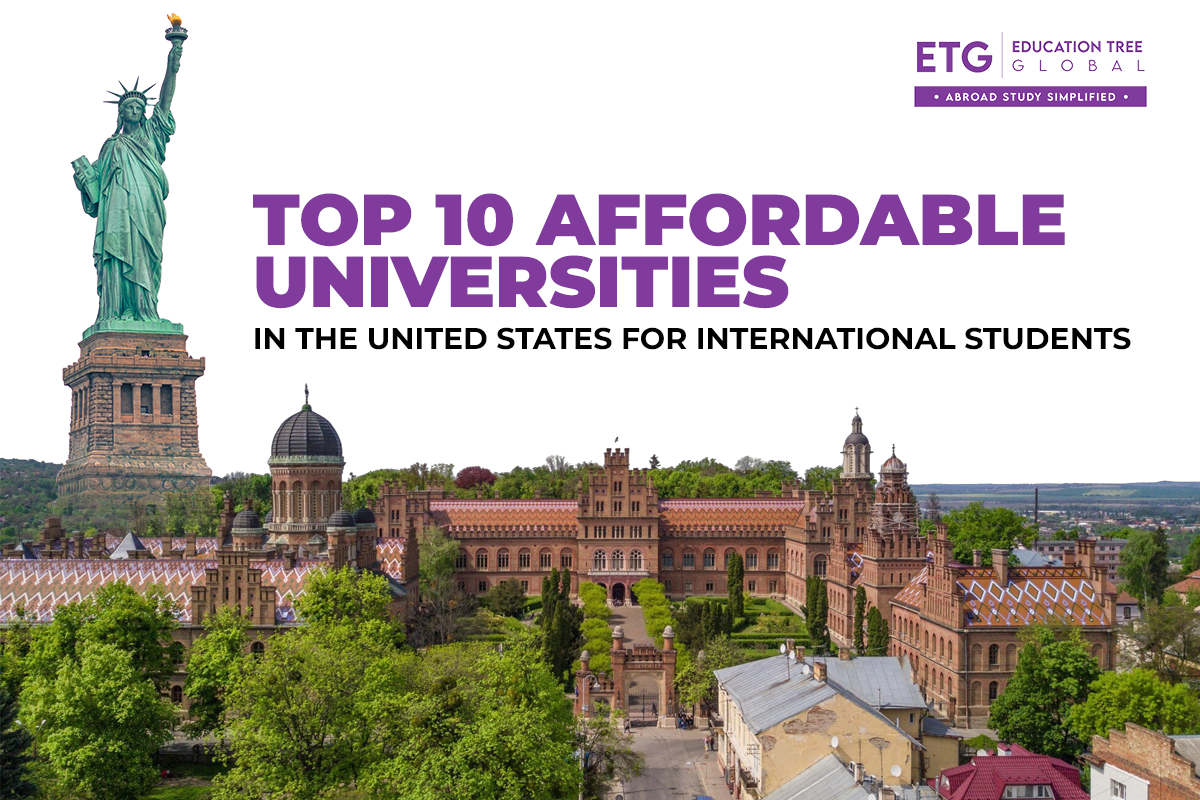
10 Cheapest US Universities for Nepalese Students: 2025 Review

Choosing to study in the USA is a massive financial commitment for any Nepalese family. With over 15,000 Nepalese students currently pursuing degrees there, the demand is high, but so are the costs. Most families aim for a “sweet spot” budget of USD 15,000–25,000 per year (NPR 20–33 Lakhs).

However, finding a university that fits this budget and has a supportive community is tough. This guide cuts through the noise. We have verified the 2025-2026 costs for 10 specific universities that are truly affordable. Whether you need low tuition, high acceptance rates, or a specific STEM program, this list uses real data to help you make the right choice.

10 Affordable Universities in USA: 2025 Cost Breakdown (NPR)

This table gives you a quick snapshot of the annual costs (Tuition + Living) and your chances of getting in.

Rank University Location Annual Cost (NPR) Acceptance Rate Merit Scholarships
1 Eastern New Mexico University Portales, NM 19.38 L 75% USD 5-10K
2 Chadron State College Chadron, NE 18.32 L 95% USD 4-8K
3 Valley City State University Valley City, ND 21.01 L 82% USD 3.5-7.5K
4 Dickinson State University Dickinson, ND 21.28 L 85% USD 4-8K
5 Minot State University Minot, ND 21.71 L 77% USD 3-8K
6 Bemidji State University Bemidji, MN 27.14 L 75% USD 5-12K
7 Arkansas State University Jonesboro, AR 22.91 L 80% USD 3-10K
8 Alcorn State University Lorman, MS 22.59 L 98% USD 3-18K
9 Univ. of Central Arkansas Conway, AR 23.70 L 85% USD 4-9K
10 University of Wyoming Laramie, WY 28.87 L 75% USD 4-7.5K

ETG Expert Tip: The “Annual Cost” listed above is critical. This is roughly the amount you need to show in your Bank Balance Certificate (from a Class A Bank) to receive your I-20 form.

10 Cheapest Universities in USA for International Students: Detailed Review

1. Eastern New Mexico University (ENMU)

ENMU is consistently the most affordable option for international students. With a total annual cost of NPR 19.38 Lakhs, it fits tight family budgets. The biggest win here is the low financial documentation required for your visa. You only need to show around USD 15,500–20,000 to get your I-20, which is significantly lower than the USD 30k+ required by most universities. The campus has a growing community of 30–50 Nepali students, providing a decent support system in a quiet, study-focused environment.

2. Chadron State College

If your main concern is securing an acceptance letter, Chadron State is a strong option. It has a 95% acceptance rate, making it very accessible for students with average academic profiles. Located in Nebraska, the cost of living is significantly lower than the national average, keeping your total expenses around NPR 18.32 Lakhs. While the location is rural, this ensures you save money on rent and distractions. There are currently 20–40 Nepali students on campus.

3. Valley City State University (VCSU)

VCSU is known as a “laptop campus,” meaning every full-time student receives a laptop to use for their studies. This tech-forward approach adds value to the NPR 21.01 Lakhs annual cost. The class sizes are small, which is excellent if you prefer direct access to professors rather than sitting in massive lecture halls. The Nepalese community is smaller here (15–35 students), so it is better suited for students who are independent and want to immerse themselves in the local culture.

4. Dickinson State University

Dickinson State is strategically located near North Dakota’s energy sector. For a Nepalese student, this is important because the local economy is robust, often leading to higher-than-average part-time wages ($16–20 per hour). The total cost is manageable at NPR 21.28 Lakhs. The university has seen a steady increase in Nepalese enrollment (20–40 students), meaning the community support is growing every year. It is a practical choice if you want to balance your studies with part-time work.

5. Minot State University

Minot State hosts the largest Nepalese community in North Dakota, with 50–80 students. This creates a strong “home away from home” environment where seniors often help new students find housing and campus jobs. The university is well-resourced, offering excellent student services and facilities for a total cost of NPR 21.71 Lakhs. Be prepared for cold winters, but the strong community and availability of on-campus jobs ($12–15/hr) make it a very popular choice.

6. Bemidji State University

Bemidji State has a unique pricing model: international students pay the same in-state tuition rate as local US residents. This policy keeps the tuition competitive. The total cost is slightly higher at NPR 27.14 Lakhs, but this includes mandatory health insurance. The campus is famous for its tunnel system, allowing you to walk between classes comfortably during winter. With 60–100 Nepali students, it has one of the most active Nepalese student clubs on this list, organizing regular festivals and events.

7. Arkansas State University

If you are looking for a large, established community, Arkansas State is the top pick. It hosts 80–150 Nepali students, the largest cohort on this affordable list. This large network makes finding accommodation, roommates, and used textbooks much easier. Located in Jonesboro, it is also relatively close (7 hours) to Dallas, a major US hub for Nepalese expats. At NPR 22.91 Lakhs, you get a “big university” experience with excellent labs and libraries at a reasonable price.

8. Alcorn State University

Alcorn State is an HBCU (Historically Black College/University), which ensures a highly inclusive and supportive environment for international students. With a 98% acceptance rate, admission is nearly guaranteed if you meet the basic requirements. The cost is attractive at NPR 22.59 Lakhs, but the real draw is the scholarship potential. High-performing students (high GPA or ACT scores) can secure up to $18,000 in aid, significantly dropping the cost further.

9. University of Central Arkansas (UCA)

UCA offers a more urban experience compared to the others. Located in Conway, a mid-sized city, it provides better access to off-campus amenities and networking opportunities. The annual cost is NPR 23.70 Lakhs. The campus infrastructure is modern, and there is a solid community of 40–70 Nepali students. This is the right choice if you want affordable tuition but prefer living in a city rather than a rural college town.

10. University of Wyoming

This is the premier choice for STEM (Science, Technology, Engineering, Math) students. While the cost is higher at NPR 28.87 Lakhs, the Return on Investment (ROI) is superior. Graduates from STEM programs here qualify for a 3-year work visa (STEM OPT), whereas non-STEM graduates only get 1 year. The engineering facilities are top-tier, and graduates often secure high-paying jobs starting at $60,000+. If your goal is a career in engineering or IT, this is the best investment.

Total Cost Without Scholarship vs Australia & Canada

Many competitors ignore the 50-60% of students who do not secure scholarships. Even without aid, the USA remains highly competitive compared to Australia or Canada.

4-Year Total Investment Comparison (No Scholarship):

University Annual Cost (NPR) 4-Year Total (NPR) Australia 4-Year Canada 4-Year
ENMU 19.38 L 77.52 L 250+ L 150+ L
Chadron 18.32 L 73.28 L 250+ L 150+ L
Minot State 21.71 L 86.84 L 250+ L 150+ L
U. Wyoming 28.87 L 115.48 L 250+ L 150+ L

The Reality: Even at full price, affordable US universities cost NPR 73-115 Lakhs for a degree. Australia often exceeds NPR 250 Lakhs. For non-scholarship families, the USA is the financial winner.

Merit Scholarship Strategy for Nepalese Students

Merit scholarships are not a lottery; they are based on your NEB +2 GPA. Here is the tiered strategy to maximize your success:

  • Safety Tier (95% Odds):
    • Alcorn State (98%): GPA 50%+ → $3-5K
    • Chadron State (95%): GPA 45%+ → $4-6K
  • Target Tier (80% Odds):
    • ENMU (75%): GPA 50%+ → $5-7K
    • Bemidji State (75%): GPA 55%+ → $8-10K + In-state tuition
  • Reach Tier (High Profile):
    • U. Wyoming (75%): GPA 65%+ → $5-7.5K (Engineering focus)

ETG Expert Tip: Apply to 4 universities (1 Safety, 2 Target, 1 Reach). If you have a TOEFL score of 80+, you may qualify for an additional $1-3K bonus at many of these schools.

Nepalese Student Communities in USA

For 70% of students, “Will I feel alone?” is a major concern. Choosing a university near a Nepalese hub provides emotional security.

Largest Campus Communities:

  1. Arkansas State: 150+ Nepalese students
  2. Bemidji State: 100+ Nepalese students
  3. Minot State: 80+ Nepalese students

Nearest Major Nepalese Hubs (USA):

  • Dallas, Texas (Largest Hub): 15-20K Nepali residents. (Closest to: Arkansas State, Alcorn).
  • Minneapolis-St. Paul: 5-8K Nepali residents. (Closest to: Bemidji State, Minot State).

New York (Jackson Heights): 10-20K Nepali residents.

USA Study Abroad Application Timeline

  • Month 1-2: Identify your profile. Are you budget-focused (ENMU) or community-focused (Bemidji)? Pick your 4 universities.
  • Month 2-3: Take TOEFL (Cost: $210 / ~NPR 28K) or IELTS. Most of these universities accept TOEFL 61+.
  • Month 3-4: Submit applications ($50 fee each).
  • Month 4-5: Bank Balance Certificate: Prepare financial proof (Class A Banks like Nabil or Everest) showing $15,500–25,000 to get your I-20.
  • Month 5-6: F-1 Visa Interview: This is the most critical step. You must explain why you chose this specific university and your intent to return to Nepal.
  • Month 6+: Book flights, insurance, and connect with ETG alumni on campus.

Conclusion: Making the Smartest Investment

Affordable US universities are strong competitors to Australia and Canada, especially for families funding their own education.

  • Budget Conscious? Go for ENMU.
  • Worried about Admission? Pick Alcorn or Chadron.
  • Need Community? Choose Bemidji or Arkansas State.
  • Career Focused? Choose Wyoming.

The Winning Move: The USA offers the highest return on investment. After 4 years, your earnings can repay your family’s investment in as little as 14 months.

Take the next step: Book a free consultation at Education Tree Global, Kamalpokhari. We will help you analyze which university fits your NEB profile, family budget, and visa goals. We have guided over 5,000 Nepalese students on this exact journey.

5 Best Countries to Study and Work for Nepalese Students in 2025

Choosing where to study abroad is one of the biggest decisions you’ll make. Every year, over 112,000 Nepalese students apply for study visas. Most choose between Australia, Canada, UK, USA, and New Zealand. Why? These countries offer quality education, real work opportunities, and clear pathways to permanent residency (PR). But which one fits YOUR budget, timeline, and career goals? This guide breaks down all five countries. We show exact costs in NPR, visa requirements for NEB +2 students, and how much you can realistically earn and send home. By the end, you’ll know exactly where to apply.

Why Choose These 5 Countries for Your Study Abroad Journey?

Not all study-abroad countries are equal for Nepalese students. We ranked these five based on three factors: strong post-study work visas, active Nepalese communities, and realistic earning potential in NPR.

The data speaks clearly:

  • Australia: 15,000+ Nepali students (largest community), 18-month to 3-year work visas, strong PR pathways.
  • Canada: Fastest PR route, 3-year work permits (PGWP), 8,000-10,000 Nepali students—growing yearly.
  • UK: Prestige degrees, 18-month work visa (new 2025 rule—down from 2 years), 3,000-5,000 Nepali students.
  • USA: Highest earning potential, 12-36 months OPT for STEM, scattered Nepali communities (4,000-6,000).
  • New Zealand: Most affordable, easiest visa approval (2-3%), 1,000-2,000 Nepali students, strong support system.

 ETG Expert Tip: The “best” country isn’t the cheapest or most prestigious. It’s the one matching YOUR family budget, English proficiency, and 5-year goals (work visa? PR? Return to Nepal?).

Cost of Studying Abroad for Nepalese Students (NPR Comparison)

Here’s the critical data every Nepalese student and parent needs to plan their education loan and budget:

Country Annual Tuition Living Cost/Month Work Hours Post-Study Visa Approx. Monthly Earnings
Australia AUD 20-45K
(w~NPR 17.8-40 L)
AUD 1,300-1,800
(w~NPR 1.15-1.6 L)
40 hrs/fortnight 18 months–3 years ~NPR 1.42-1.78 L
Canada CAD 15-25K
(w~NPR 14.7-24.5 L)
CAD 830-1,600
(w~NPR 81-156 K)
20 hrs/week Up to 3 years (PGWP) ~NPR 1.25-1.4 L
UK £9,250-30K
(w~NPR 13-43 L)
£815-1,390
(w~NPR 1.14-1.95 L)
20 hrs/week 18 months ~NPR 1.16 L
USA USD 10-60K
(w~NPR 1.32-7.92 L)
USD 980-1,950
(w~NPR 1.29-2.57 L)
20 hrs/week (On-campus) 12-36 months (OPT) ~NPR 1.64-1.9 L
New Zealand NZD 20-30K
(w~NPR 16-24 L)
NZD 520-885
(w~NPR 41.6-70.8 K)
20 hrs/week 1-3 years ~NPR 1.34-1.6 L

Key insight for families: If you earn NPR 1.5 Lakhs/month while studying, you can cover 50-70% of your living costs. Your family’s investment drops significantly.

 ETG Expert Tip: New Zealand and Canada offer the lowest first-year total cost. Australia has the largest Nepali community. USA pays highest hourly wages but costs most upfront.

Pre-Visa & Processing Costs in Nepal

Most students budget for tuition but forget the NPR 2–3 Lakhs you need before you even get a visa.

Hidden Expense Estimated Cost (NPR) Why You Need It
Property Valuation NPR 15,000 – 50,000 To show financial strength (valuation report by engineer).
Bank Balance Cert. NPR 1,000 – 5,000 Charged by Class A banks to issue official letters.
UK IHS Fee ~NPR 1.35 Lakhs/yr Mandatory health surcharge paid before visa.
Aus OSHC Insurance ~NPR 50,000 – 80,000 Mandatory health cover paid before visa.

ETG Expert Tip: For your Education Loan, prioritize Class A Commercial Banks like Nabil Bank, Global IME, or Everest Bank. Visa officers in Australia and NZ trust these documents more than smaller development banks.

Visa & Academic Requirements for NEB (+2) Graduates

Your NEB or HSEB +2 marks matter. Here’s what each country requires from Nepalese applicants:

Entry Requirements (NEB/+2 Marks)

  • Australia: 50%+ average (most universities accept NEB +2 directly).
  • Canada: 55%+ (varies by province; Ontario universities prefer 60%+).
  • UK: 60%+ for competitive universities (45%+ for pathway programs).
  • USA: No specific +2 percentage, BUT SAT/ACT often required (1,200+ for top universities; test-optional at many 2025).
  • New Zealand: 60%+ for direct entry (45%+ for pathway programs).

English Proficiency (Mandatory for All)

  • IELTS: 6.0-6.5 (Australia, Canada, UK, New Zealand).
  • TOEFL iBT: 80-100 (USA, UK).
  • PTE: 50-58 (Australia, Canada).
  • Exam cost: ~NPR 20,000-30,000.

Study Gap Acceptance for Australia, Canada & UK

Country Acceptable Gap (Bachelor’s) Strictness Level
Australia 1-2 Years Strict: Gaps >2 years need strong work evidence & tax docs.
Canada 2-3 Years Very Strict: 3+ year gap for Diploma is a major visa risk.
UK 2-3 Years Flexible: Accepts gaps if intent to study is genuine.
USA Flexible Flexible: Focuses on interview & explaining the gap.

Top Cities with Nepalese Communities in Australia, UK & USA

Parents worry about who will help you find a room. Choosing a suburb with a strong Nepalese community provides immediate support.

  • Australia (Sydney): Rockdale (16% Nepalese), Auburn, and Hurstville. In Melbourne, look at Glenroy or Brunswick.
  • UK (London): Plumstead, Woolwich, and Aldershot (often called “Little Nepal” due to Gurkha families).
  • USA: Jackson Heights (Queens, NY) and Irving (Texas) have huge communities.

Canada (Toronto): Areas near McCowan Rd & Victoria Park (Scarborough) are hubs for Nepalese families.

No Objection Certificate (NOC) Application Process in Nepal

This is the document Nepalese students fear most. Here’s the truth about the No Objection Certificate (NOC):

Step Who Does It Time Cost Mandatory
Submit documents to Ministry of Education, Nepal You (with ETG’s checklist) 2-3 working days NPR 2,000 Yes (Except USA*)
Ministry issues NOC letter Ministry of Education 1 day Included Yes (Except USA*)
Upload to visa application You Same day Free Yes

Common NOC Mistake: Applying too late. Your NOC is valid for 6 months only. Apply 3-4 months before your intended intake.

ETG Expert Tip: Students who skip NOC early often miss visa deadlines by 2-3 weeks. Start the NOC process immediately after receiving your admission offer.

PR Pathways and Points Calculation for Nepalese Students

Instead of guessing, let’s look at a real 2025 scenario for an Australian PR (Subclass 189/190).

Example: A 25-year-old Nepalese student finishes a Nursing or IT degree in Adelaide (Regional).

  • Age (25-32): 30 Points
  • Bachelor’s Degree: 15 Points
  • Australian Study (2 years): 5 Points
  • Regional Study: 5 Points
  • Superior English (PTE 79+): 20 Points
  • Total: 75 Points

Result: This score is highly competitive for a PR invite.

Scholarships and Part-Time Earning Potential Abroad

Scholarships for Nepalese Students

Not all countries offer equal scholarships. Here are the top ones to target:

  • Australia: Australia Awards Scholarship (full tuition + living + airfare; highly competitive).
  • Canada: Vanier Graduate Scholarship (CAD 50,000/year for PhD; STEM focus).
  • UK: Chevening Scholarship (full tuition + living + airfare; postgraduate only).
  • USA: Fulbright Nepal Scholarship (full support; highly selective); university merit scholarships vary.
  • New Zealand: University of Auckland & Otago offer NZD 5-20K/year merit aid.

Real Earnings Math for Families

If your child works 20 hours/week at minimum wage:

  • Canada: CAD 1,280-1,440/month = ~NPR 1.25-1.4 Lakhs (covers 60-70% of living costs).
  • Australia: AUD 1,600-2,000/fortnight = ~NPR 1.42-1.78 Lakhs (covers 80-90% of living costs).
  • UK: £833/month = ~NPR 1.16 Lakhs (covers 50-60% of living costs).

Bottom line: Your child isn’t dependent on monthly remittances. Part-time work funds their living costs.

Study Abroad Application Timeline for Nepalese Students

Month 1-2: Research & Eligibility

  • Check your NEB +2 marks against each country’s requirements.
  • Take IELTS/PTE/TOEFL exam (book 6-8 weeks in advance).
  • Make a shortlist: 2-3 countries that fit your budget.

Month 2-3: Applications & NOC

  • Apply to universities (deadlines vary; check intakes above).
  • Prepare NOC documents: citizenship certificate, +2 marksheet, admission letter.
  • Book a free consultation with ETG counsellors at Kamalpokhari.

Month 3-4: Visa & Financial Proof

  • Gather financial proof (Class A Bank statements, property valuations in NPR).
  • Submit visa application with NOC.
  • Prepare for visa interview (mock interview with ETG).

Month 4+: Departure

  • Arrange accommodation, airfare, and travel insurance.
  • Join ETG’s WhatsApp alumni group for your country.
  • Pack and prepare for your new chapter.

Conclusion: Which Country is Best for You?

All five countries offer quality education and work opportunities. The right choice depends on your budget, English proficiency, career goals, and family situation.

Quick decision framework:

  • Tight budget?New Zealand or Canada (lowest first-year cost).
  • Want PR quickly?Canada (fastest pathway, 3-year PGWP) or Regional Australia.
  • Largest community?Australia (15,000+ Nepali students = instant support).
  • Highest earnings?USA or Australia (better hourly wages).
  • Easiest visa?New Zealand (2-3% rejection rate).

One truth: Every successful study-abroad journey starts with a mentor who knows the NOC process, visa rules, and Nepalese family realities.

That’s what we do at Education Tree Global.

Book a free consultation at our Kamalpokhari office today.

How to Write the Perfect Resume for Studying Abroad (With Free Samples!)

Dreaming of studying abroad? Whether it’s walking through the halls of your dream university in Canada, sipping coffee between lectures in Germany, or researching alongside global scholars in the UK, there’s one document that can make or break your journey — your resume.

Your resume is much more than a piece of paper. It’s a snapshot of your story, a reflection of your dedication, and a summary of everything you’ve accomplished so far. For international applications, it’s often the first impression you make on the admissions committee — and we all know how powerful first impressions can be.

In this guide, we’ll take you through how to write a stunning resume for studying abroad, with simple steps, expert tips, and free downloadable samples you can edit for your own application. Whether you’re a high school graduate, a college student, or a research aspirant, this guide will help you showcase your journey in the best light possible.

Why a Great Resume Matters When Applying Abroad

When applying to a university overseas, your resume — or CV, depending on the country — is your personal introduction. It tells the admissions team who you are before they ever read your essays or recommendation letters. It’s the story of your academic growth, your passions, your experiences, and your readiness to step into a global classroom.

In places like the United States, Canada, the United Kingdom, Germany, and Australia, a resume is not just optional — it’s an integral part of your application package, especially for graduate or research-based programs.

Even for undergraduate applicants, a well-written resume can give you an edge when applying for scholarships, exchange programs, or internships.

Think of your resume as a bridge — connecting your current achievements to your future aspirations. It’s your chance to say, “Here’s who I am, here’s what I’ve done, and here’s why I belong in your program.”

Study Abroad Resume vs. Job Resume: What’s the Difference?

Here’s something most students overlook: a resume for studying abroad isn’t the same as a resume for a job. They may look similar on the surface, but their focus and tone are quite different.

Let’s break it down:

Aspect Study Abroad Resume Job Resume
Focus Academic achievements, research, leadership, and learning potential Professional achievements, roles, and measurable results
Length 1–2 pages (can go up to 3 for research-heavy programs) Typically 1 page
Sections Education, Projects, Research, Skills, Extracurriculars Work Experience, Achievements, Skills
Tone Academic and formal Professional and result-driven

A study abroad resume focuses more on your intellectual curiosity, academic record, and global mindset, rather than your professional accomplishments. It’s not about how much revenue you helped generate — it’s about how you learned, contributed, and grew.

Step-by-Step Guide: How to Write a Resume for Studying Abroad

Creating your resume might sound intimidating, but it’s actually quite doable once you understand the structure. Let’s go step by step.

1. Start with a Clean, Professional Header

Your header is the very first thing an admissions officer sees — so keep it simple, polished, and clear. Include:

  • Your full name
    Professional email address (avoid using casual ones like cutiepie99@gmail 😅)
  • Phone number
  • LinkedIn profile (optional but recommended)
  • City and country (no need for your full home address)

Pro Tip: Use a clean, readable font like Calibri or Arial, and make sure your name stands out slightly with a larger font size.

2. Craft a Compelling Objective Statement

Your objective statement is like your short personal introduction — a two- to three-line summary that quickly tells the reader what you’re aiming for and why.

It should reflect your academic goals, area of interest, and enthusiasm for international learning.

Example:

“Motivated undergraduate in Mechanical Engineering aspiring to pursue a Master’s in Renewable Energy at the University of British Columbia. Passionate about sustainable technologies and global research collaboration.”

Notice how it highlights the student’s background, goal, and passion all in one neat paragraph. That’s what you’re going for — short, sincere, and specific.

3. Highlight Your Education Clearly

Your education section is the foundation of your resume. List your most recent qualification first, and work backward.

Include your degree name, institution, study duration, GPA/percentage, and any relevant coursework that connects with your target field.

Example:
Bachelor of Technology in Computer Science
Delhi Technological University | 2022 – Present
CGPA: 8.7/10
Relevant Courses: Data Structures, Artificial Intelligence, Cloud Computing

If you’ve done any online certifications, exchange semesters, or notable projects — this is the place to mention them.

4. Add Projects That Show Your Initiative

Universities love to see evidence of hands-on learning. Projects show that you’ve gone beyond textbooks to apply your knowledge creatively.

Example:
AI Chatbot for Student Counseling | Python, TensorFlow
Developed a chatbot to assist university students with course selection. Achieved 92% accuracy in response prediction.

Try to describe each project in one or two bullet points, mentioning the tools or methods used, and the outcome or result.

5. Include Research, Internships, and Work Experience

Even short internships, part-time jobs, or volunteer work show initiative and commitment. Don’t underestimate small experiences — they reveal your drive and adaptability.

Example:
Research Intern | IIT Delhi | June 2023 – Aug 2023
Worked on sentiment analysis of educational feedback using NLP models.

If your experience ties to your chosen program (like research in renewable energy for an environmental engineering degree), emphasize that connection.

6. Highlight Extracurriculars and Leadership

Admissions officers want students who are more than just good at academics. They’re looking for global citizens — people who can lead, collaborate, and contribute to campus life.

Example:
President – Coding Club | 2023–24
Organized 4 national hackathons and increased club membership by 60%.

Whether it’s sports, volunteering, art, or public speaking — show what makes you a well-rounded person.

7. Wrap Up with Skills and Achievements

This is where you neatly list your technical and soft skills, as well as any certifications or awards.

Example:
Programming: Python, Java, SQL
Languages: English (Fluent), German (Beginner)
Certifications: Coursera – Machine Learning by Stanford

Don’t cram everything in here. Keep it relevant, clean, and easy to scan.

Sample Resume Templates for Students

Here are a few samples to give you an idea of how everything fits together:

Sample Resume 1 – Undergraduate Student

Riya Gurung
Pokhara, Nepal | riya.gurung@email.com | LinkedIn

Objective:
Ambitious high school graduate passionate about pursuing a Bachelor’s degree in Business Administration at the University of Toronto. Dedicated to developing strong analytical and leadership skills.

Education:
St. Xavier’s College, Kathmandu | Class XII (2025)
HSEB Percentage: 94.2%

Projects:

  • Created a Social Media Marketing Plan for a local NGO, boosting engagement by 40%.
  • Designed a Financial Literacy Campaign for school students.

Extracurricular Activities:

  • Captain, Debate Team (2nd place, National Level)
  • Volunteer, Teach for India (40 hours of service)

Skills:
Microsoft Office, Canva, Communication, Team Leadership

Sample Resume 2 – Graduate Student

Amit Khanal
Biratnagar, Nepal | amit.khanal@email.com | LinkedIn | GitHub

Objective:
Engineering graduate seeking to pursue a Master’s in Data Science at the University of Melbourne to deepen expertise in machine learning and big data analytics.

Education:
B.Tech in Computer Science | VIT University | 2021 – 2025
CGPA: 8.6/10

Research & Projects:

  • Thesis: Predictive Modeling for Road Traffic using Python & TensorFlow
  • Project: Image Recognition Model with 94% accuracy (Keras, CNN)

Internships:
Data Analyst Intern | TCS | June – Aug 2024

  • Cleaned and analyzed large datasets to identify user behavior patterns.

Leadership:
Vice-President, Data Science Club – Organized 5 data hackathons.

Skills:
Python, R, SQL, Tableau, ML Algorithms, Statistical Analysis

Sample Resume 3 – Research-Oriented Master’s Applicant

Priya Shrestha
Lalitpur, Nepal | priya.shrestha@email.com | LinkedIn

Objective:
Aspiring researcher aiming to pursue a Master’s in Biomedical Engineering at Imperial College London. Focused on research in tissue regeneration and nanomedicine.

Education:
B.E. Biomedical Engineering | Kathmandu University | 2020 – 2024 | CGPA: 3.8

Research Experience:
Research Assistant | Kathmandu University | Jan – July 2024

  • Worked on “Nanoparticle Drug Delivery for Cancer Therapy.”
  • Co-authored paper in Biomedical Research Journal.

Achievements:

  • Recipient, Young Innovator Award 2023
    Published 2 research papers

Skills:
MATLAB, Python, Biomedical Imaging, Laboratory Techniques

Pro Tips for a Winning Resume

  • Keep it concise — two pages maximum
  • Use strong, action-oriented verbs (developed, analyzed, designed, implemented)
  • Quantify your achievements when possible (numbers grab attention!)
  • Stick to a clean, ATS-friendly format (avoid colorful or heavily graphic designs)
  • Proofread thoroughly — typos can leave a bad impression

Final Thoughts

Your resume is your passport to global opportunities. It’s the very first step toward building the international education experience you’ve been dreaming about.

Take your time to shape it carefully. Don’t rush it, and don’t just copy someone else’s format — make it authentically yours. Highlight your growth, your curiosity, and the experiences that have shaped who you are.

Remember: a great resume doesn’t just list achievements — it tells a story. It shows your potential, your values, and your readiness to learn from the world.

So open that Word doc, take a deep breath, and start writing your story — one line at a time.

NOC (No Objection Certificate) Nepal 2026: Complete Guide for Nepali Students Studying Abroad

Are you a Nepali student planning to study abroad in 2026? Then you need to know about one document before anything else: the No Objection Certificate (NOC). Issued by the Ministry of Education, Science and Technology (MoEST), this is not a formality you can skip. Without a valid NOC, Nepali banks will refuse your fee remittance, immigration may stop you at TIA, and your visa application will be incomplete.

This is the most complete and up-to-date NOC guide for Nepali students in 2026. We cover the new online-only application process, updated office location (Sanothimi, Bhaktapur, not Keshar Mahal), the latest TU/KU integration news, South Korea suspension update, 2026 processing times, and answers to every question.

QUICK ANSWER NOC Nepal 2026 (For Google Featured Snippet)

NOC (No Objection Certificate) is an official document issued by MoEST, Nepal, permitting Nepali students to study abroad.

Fee: Rs. 2,000 | Processing: 1-5 working days | Apply online: noc.moest.gov.np

Office: Sanothimi, Bhaktapur (NOT Keshar Mahal) | Hours: Sun-Fri, 10 AM-4 PM

NOC को पूरा नाम No Objection Certificate हो। यो नेपाल सरकारको शिक्षा, विज्ञान तथा प्रविधि मन्त्रालयद्वारा जारी गरिने एक आधिकारिक अनुमति पत्र हो जसले Nepali students लाई विदेशमा उच्च शिक्षा लिन जान अनुमति दिन्छ।

What Is NOC? Full Form, Meaning & Definition in Nepal (2026)

NOC stands for No Objection Certificate. In Nepal, it is officially called the Foreign Study Approval Letter (अध्ययन अनुमति पत्र) and is issued by the Foreign Study Permit Branch (Scholarship Wing) under MoEST.

The NOC certifies that the Government of Nepal has no legal objection to a Nepali citizen leaving the country to study at a recognized foreign institution. As of 2026, the entire NOC system is moving fully online all 10,931 NOCs issued so far in 2026 have been processed through the digital portal, according to MoEST data published by the Kathmandu Post (April 28, 2026).

NOC Full Form in Nepali: अध्ययन अनुमति पत्र (Adhyayan Anumati Patra). NOC meaning in Nepali: यो सरकारले विद्यार्थीलाई विदेशमा अध्ययन गर्न दिने आधिकारिक अनुमति पत्र हो।

2026 BREAKING UPDATE Full Online System Now Live

  • Since April 2026: MoEST has integrated Tribhuvan University (TU) and Kathmandu University (KU) into the online NOC portal.
  • Students with NEB, TU, or KU academic records can now complete the ENTIRE process from home, no office visit needed.
  • Total NOCs issued since 2023 online system launch: 339,851 | Online issuance 2026: 10,931 (100% online so far in 2026).
  • Target: 50% of all applicants to receive NOC fully from home by end of 2026.
  • Source: Kathmandu Post, April 28, 2026 | MoEST NOC Branch Chief Birendra Jung Thapa

Why Is NOC Required for Nepali Students Going Abroad?

Nepal mandates the NOC under its education and immigration laws for four key reasons:

Reason What It Means for You
Legal Requirement Under Scholarships Act 2021, Scholarship Rules 2060, and Foreign Study Approval Guidelines 2023
Airport Immigration No NOC = immigration officers at TIA may stop or repatriate you
Foreign Exchange Nepali banks require NOC to process overseas tuition and living expense transfers
Institution Verification Ensures you enroll only in MoEST-recognized foreign institutions
Student Protection Prevents misleading enrollment in fraudulent or blacklisted programs

Who Needs an NOC? Eligibility in 2026

Any Nepali citizen enrolling in a foreign educational program that requires fee remittance or a student visa needs an NOC. This includes:

  • Students applying for bachelor’s, master’s, or PhD programs at recognized foreign universities
  • Students enrolling in diploma or vocational programs at recognized foreign institutions
  • Students in language programs at recognized institutions (subject to country-specific rules see South Korea update below)
  • Both self-funded and sponsored students need an NOC for fee remittance via Nepali banks
  • Students transferring to a new institution abroad also need a fresh NOC for the new institution
IMPORTANT 2025-2026 POLICY: South Korea NOC Suspension

In May 2025, MoEST temporarily suspended NOCs for D-2 (academic) and D-4 (language) visas for South Korea.

Reason: Reports of students enrolling in blacklisted Korean institutions and being misled by consultancies.

May 27, 2025: Nepal Supreme Court issued a stay order, preventing the suspension for students who had already completed all procedures.

Master’s level NOCs for South Korea were NOT halted only undergraduate and language programs.

2026 status: Verify current South Korea NOC status on noc.moest.gov.np before applying.

Action: If you are targeting South Korea, contact ETG counsellors for the latest update before applying.

Documents Required for NOC in Nepal 2026 Complete Checklist

The following documents are required for both online and offline NOC applications as of 2026:

# Document Important Notes
1 Offer / Acceptance Letter From recognized foreign institution must state name, course, level, intake & duration
2 Academic Transcripts & Certificates SLC/SEE, +2, Bachelor’s marksheets as applicable scanned PDF, clear quality
3 Citizenship Certificate Name must match ALL academic documents exactly (most common rejection cause)
4 Passport Copy Valid passport, photo page + data page
5 Financial Documents Bank statement or sponsorship letter showing funds for tuition + living expenses
6 NOC Application Form Available on noc.moest.gov.np or collected at Sanothimi office
7 Fee Payment Receipt Rs. 2,000 paid online or at Rastriya Banijya Bank
8 Name Verification Letter (if needed) From your ward office if name differs between citizenship and academic docs
9 Foreign Language Offer Letter Translation If offer letter is NOT in English get it translated at Bishwa Bhasa Nepal
PRO TIP from ETG Counsellors

  • Upload all scanned documents as clear PDFs. Blurry images are the #2 reason for online NOC rejection.
  • Register on the portal using your Master ID linked to your National ID / Citizenship number.
  • Your name, DOB, and ID numbers must match exactly across citizenship, passport, and offer letter.
  • Applying for multiple institutions? You need separate NOC applications for each one.

How to Apply for NOC Online in Nepal 2026 Step-by-Step (noc.moest.gov.np)

The NOC process is now primarily online via the official MoEST portal. Here are the updated steps for 2026:

  • Visit the official NOC portal: noc.moest.gov.np
  • Click ‘NOC Application’ → Register with your email and mobile number (Master ID linked to your National ID / Citizenship)
  • Fill in personal details, name, DOB, and address exactly matching your citizenship certificate
  • Enter your study details: destination country, institution, course, academic level, and intake date (match your offer letter exactly)
  • Upload all required documents in PDF format (clear scans only, blurry uploads cause rejection)
  • Review every detail carefully before submission, even small errors require an in-person visit to fix
  • Submit the application online
  • Pay the Rs. 2,000 fee online via the portal’s integrated payment system
  • Wait for MoEST verification 1 to 5 working days (check application status via SMS or portal)
  • Download and print your NOC from the portal. Once approved, it includes a digitally verifiable QR code
OFFLINE APPLICATION (if online not possible)

Download form from noc.moest.gov.np OR collect it at MoEST office, Sanothimi, Bhaktapur

Window 3: Document Verification | Window 2: Pay Rs. 2,000 fee | Window 4: Submit documents & get token

Window 6: Collect your NOC. Physical collection possible in 1 day if all documents are correct.

Address: MoEST NOC Branch, Sanothimi (Madhyapur Thimi), Bhaktapur, Nepal

NOC Fee in Nepal 2026 How Much Does It Cost?

NOC FEE OFFICIAL 2026 DETAILS

Current Fee:   Rs. 2,000 (NPR 2,000) per application

Per institution:  Separate fee required for each institution / country / academic level

Payment Methods:  Online via noc.moest.gov.np portal  OR  Rastriya Banijya Bank (for offline applicants)

Keep receipt:  Attach payment receipt to your application file

Always verify the current fee on noc.moest.gov.np as it may be updated without notice.

How Long Does It Take to Get NOC in Nepal? 2026 Processing Time

The official NOC processing time as of 2026 is 1-5 working days after all documents are verified and accepted. This is an update from the previously cited 2-3 days volume has grown with over 123,092 NOCs issued in 2025 alone.

Scenario Expected Time What to Do
All documents correct, online 1-3 working days Apply through portal for fastest result
All documents correct, offline 1 day (same-day pickup possible) Go early, bring originals
Minor document discrepancy 5-7 working days Must visit Sanothimi office with originals
Institution recognition issue Delayed or Rejected Verify recognition BEFORE applying
Peak season (Mar-May, Sep-Nov) Up to 2 weeks Apply minimum 4 weeks before visa deadline

Where Is the NOC Office in Kathmandu? 2026 Address & Location

IMPORTANT CORRECTION Office Has Moved from Keshar Mahal

The NOC office is NO LONGER at Keshar Mahal, Kathmandu.

CORRECT 2026 Address:

Office Name:   Foreign Study Permit Branch (NOC Branch), MoEST

Address:       Sanothimi (Madhyapur Thimi Municipality), Bhaktapur, Nepal

Phone:         +977 1-6635419

Email:         info.noc@moest.gov.np

Website:       noc.moest.gov.np

Office Hours:  Sunday – Friday, 10:00 AM – 4:00 PM

Tip: Most students can now complete the full process online visiting Sanothimi is only needed if there are document discrepancies.

NOC Validity Period: How Long Is Your NOC Valid?

A Nepal NOC is valid until the course commencement date stated in your offer letter. In practice, it is typically treated as having a 6-month validity period from the date of issue.

  • If you do not use your NOC within approximately 6 months, you will need to reapply
  • NOC is institution-specific if you change your institution or course, you need a new NOC
  • If you change your intake (e.g., from September to January), reapply for a fresh NOC

NOC for Different Countries 2026 Country-Wise Overview

Country NOC Required? 2026 Notes
Australia Yes Standard process NOC required for CAS/CoE and bank remittance
UK Yes Required for CAS and tuition remittance through Nepali banks
Canada Yes Required for SDS and regular student visa track from Nepal
USA Yes Required for F-1 visa applications from Nepal
Lithuania Yes Required verify institution on MoEST recognized list (popular 2026 destination)
Germany Yes Required for APS process and student visa application
New Zealand Yes Required for tuition fee transfer and visa
Ireland Yes Required for Irish Study Visa from Nepal
South Korea Suspended D-2/D-4 suspended May 2025. Master’s level not suspended. Verify status at noc.moest.gov.np
Japan Yes Required verify institution recognition before applying

NOC and Migration Certificate What Is the Difference?

Many students confuse the NOC with the migration certificate. They are two separate documents:

NOC Migration Certificate
Issued by MoEST, Nepal Your previous institution / university in Nepal
Purpose Government permission to study abroad + bank remittance Academic record transfer from Nepal institution
Who asks for it Nepal immigration, your bank, visa application Foreign university academic office
When needed Before visa application Often during enrollment at foreign university
Fee Rs. 2,000 Varies by institution

Bottom line: Apply for both. Start your migration certificate from your current Nepal institution at the same time as your NOC application at MoEST Sanothimi.

Why Is NOC Rejected? Common Mistakes to Avoid in 2026

TOP 7 REASONS FOR NOC REJECTION OR DELAY

1. Name mismatch citizenship vs. academic documents (most common get ward office letter to fix)

2. Foreign institution NOT on MoEST’s recognized list check noc.moest.gov.np BEFORE applying

3. Blurry or incomplete document scans upload clear, full-page PDFs

4. Submitting duplicate applications for the same intake system flags this

5. Offer letter missing required details (student name, course, level, intake, duration)

6. Applying for South Korea D-2/D-4 without checking suspension status

7. Applying too late always apply 4 weeks before your visa submission deadline

NOC Application Checklist 2026 Before You Submit

Checklist Item
Offer / acceptance letter received contains name, course, level, intake, duration
All academic certificates and transcripts ready as clear PDF scans
Citizenship certificate name EXACTLY matches all academic documents
Ward office name verification letter obtained (if any name discrepancy)
Bank / financial proof ready for foreign exchange documentation
Rs. 2,000 fee confirmed online payment method ready
Foreign institution recognition status confirmed on noc.moest.gov.np
Registered on NOC portal with Master ID (National ID / Citizenship linked)
South Korea destination? Verified current NOC suspension status
Applying at least 4 weeks before visa submission deadline

Frequently Asked Questions About NOC in Nepal 2026

What is NOC? What is the full form of NOC in Nepal?

NOC stands for No Objection Certificate. In Nepali, it is called अध्ययन अनुमति पत्र (Adhyayan Anumati Patra). It is issued by the Ministry of Education, Science and Technology (MoEST), Government of Nepal, from the NOC Branch at Sanothimi, Bhaktapur.

What documents are required for NOC in Nepal in 2026?

Required documents: (1) Offer/acceptance letter, (2) Academic transcripts and certificates, (3) Citizenship certificate, (4) Passport copy, (5) Financial/bank documents, (6) NOC application form, (7) Rs. 2,000 fee payment receipt. If your name differs in documents, also include a ward office name verification letter.

How long does it take to get NOC in Nepal in 2026?

Standard processing time is 1-5 working days after document verification. For NEB, TU, and KU graduates using the fully online system, it can be as fast as 1-3 working days. Apply at least 4 weeks before your visa deadline.

How much is the NOC fee in Nepal 2026?

The NOC fee is Rs. 2,000 (NPR 2,000) per application. Separate fees apply for each institution, country, or academic level. Always verify the current fee on noc.moest.gov.np before paying.

Where is the NOC office in Kathmandu / Nepal?

The NOC office is at Sanothimi, Bhaktapur (NOT Keshar Mahal, Kathmandu the office has moved). Full address: Foreign Study Permit Branch, MoEST, Sanothimi, Madhyapur Thimi Municipality, Bhaktapur, Nepal. Phone: +977 1-6635419. Hours: Sunday-Friday, 10 AM-4 PM.

Can I apply for NOC online in Nepal?

Yes and as of 2026, this is the primary method. Visit noc.moest.gov.np, register with your Master ID, fill in your details, upload documents, and pay the fee online. Students with NEB, TU, or KU records can now complete the full process from home, including downloading the QR-coded NOC.

Why is NOC rejected in Nepal?

Most common reasons: name mismatch between citizenship and academic documents, institution not on MoEST’s recognized list, blurry document uploads, incomplete offer letter details, or applying for South Korea without checking current suspension status.

What is the NOC validity period?

The NOC is valid until your course start date as stated in your offer letter typically treated as a 6-month validity. If you change your intake, institution, or course, you must apply for a new NOC.

Is migration certificate required for studying abroad from Nepal?

The migration certificate (issued by your Nepal institution) and the NOC (issued by MoEST) are separate documents. The foreign university may require the migration certificate as part of academic enrollment. Apply for both simultaneously to avoid delays.

What is NOC in Nepali? (NOC को अर्थ के हो?)

NOC को पूरा नाम No Objection Certificate हो। नेपाली भाषामा यसलाई ‘अध्ययन अनुमति पत्र’ भनिन्छ। यो नेपाल सरकारको शिक्षा, विज्ञान तथा प्रविधि मन्त्रालयले Sanothimi, Bhaktapur बाट जारी गर्दछ। विदेशमा पढ्न जाने प्रत्येक नेपाली विद्यार्थीलाई यो अनिवार्य छ।

How many NOCs has Nepal issued NOC stats 2026?

According to MoEST and Kathmandu Post (April 28, 2026): Total NOCs issued since 2023 online system launch 339,851. In 2025 alone 123,092 NOCs were issued. In 2026 so far all 10,931 issued NOCs have been processed entirely online. More than 100,000 students have been applying annually since 2020.

Conclusion NOC Is Your Most Important Study Abroad Document in 2026

Nepal’s NOC system has undergone major changes in 2026. The process is now fully digital for NEB, TU, and KU graduates. The office has moved from Keshar Mahal to Sanothimi, Bhaktapur. Processing times have been updated to 1-5 working days. South Korea NOCs remain partially suspended. These updates matter outdated information can delay your entire study abroad journey.

If you’re planning to study abroad from Nepal in 2026:

  • Apply online at noc.moest.gov.np immediately after receiving your offer letter
  • Verify your institution is on MoEST’s recognized list before applying
  • Ensure your name matches perfectly across all documents
  • If targeting South Korea, check current suspension status before applying
  • Apply minimum 4 weeks before your visa submission deadline
Free NOC & Study Abroad Guidance Education Tree Global, Kathmandu

ETG has helped thousands of Nepali students navigate the NOC process and secure admissions worldwide.

Our counsellors guide you through every step: document preparation, institution recognition check, NOC submission, and visa filing.

Kamalpokhari 01, Kathmandu (Opposite City Centre)

01-5911944 / 01-5911945

enquiry@educationtreeglobal.com

educationtreeglobal.com

WhatsApp: +977 9802005804

Sources & References

Kathmandu Post ‘Over 88,000 students obtain NOCs online in three years as system expands’, April 28, 2026

  • Ministry of Education, Science and Technology, Nepal noc.moest.gov.np
  • myRepublica ‘Govt halts NOC for students planning to study in South Korea’, May 13, 2025
  • Nepal Supreme Court Stay order on South Korea NOC suspension, May 27, 2025
  • Scholarships Act 2021 (2078 B.S.), Section 3(b)
  • Foreign Study Approval Guidelines 2023, MoEST

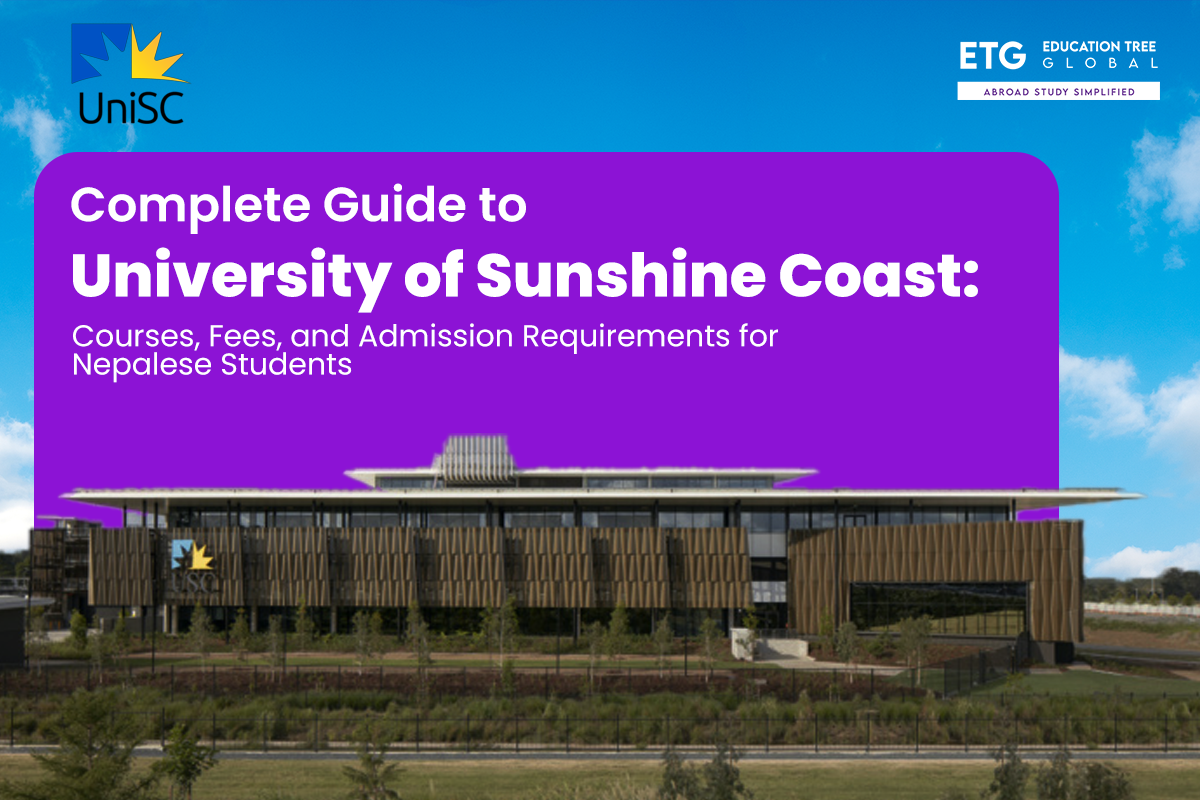
Complete Guide to University of Sunshine Coast: Courses, Fees, and Admission Requirements for Nepalese Students

Introduction

University of the Sunshine Coast (UniSC) sits on Queensland’s beautiful Sunshine Coast, just 90 minutes north of Brisbane. Founded in 1996, this young public research university has grown to serve 17,000+ students across five campuses, with 1,773 international students from 72 countries.

Nepalese students choose UniSC for its unique position as the world’s only university operating within three UNESCO Biosphere Reserves. The university’s CRICOS code 01595D ensures quality education standards, while its location offers one of Australia’s most affordable study destinations.

UniSC stands out with automatic 15% scholarships for all international students, small class sizes enabling personalized attention, and strong graduate employment rates. The Times Higher Education Impact Rankings 2024 named UniSC the top-ranked Queensland university for climate action and sustainable development goals.

Why Choose University of Sunshine Coast?

Young and Dynamic Institution
UniSC’s modern approach eliminates traditional constraints found at older universities. Founded in 1996, the institution focuses on innovation, sustainability, and real-world applications. Students benefit from cutting-edge facilities and contemporary teaching methods designed for today’s global workforce.

Exceptional Location and Environment
The Sunshine Coast offers subtropical climate, beautiful beaches, and outdoor lifestyle opportunities unavailable in major cities. Students study within UNESCO World Heritage areas while enjoying significantly lower living costs than Brisbane, Sydney, or Melbourne.

Outstanding Academic Recognition
UniSC earned 14 five-star ratings in the Good Universities Guide 2023-24, ranking in the top 5 for teaching quality and top 6 for overall student experience. The university leads Queensland in climate action initiatives and maintains strong industry connections across the region.

Comprehensive International Support
The dedicated International Student Support team provides visa guidance, cultural adaptation programs, and academic assistance. With students from 72 countries, UniSC creates truly multicultural environments where Nepalese students find welcoming communities.

Strong Employment Outcomes
Over 90% of UniSC graduates secure employment within four months of completing their studies. The university’s industry connections, work placement programs, and career services ensure students develop job-ready skills and professional networks.

Popular Courses for Nepalese Students

Undergraduate Programs (3-4 years)

Business & Commerce

  • Bachelor of Business
  • Bachelor of Commerce
  • Bachelor of Business (Digital Marketing)
  • Bachelor of Tourism and Business Management

Health & Medical Sciences

  • Bachelor of Nursing
  • Bachelor of Medical Science
  • Bachelor of Biomedical Science
  • Bachelor of Clinical Exercise Physiology
  • Bachelor of Paramedicine
  • Bachelor of Occupational Therapy
  • Bachelor of Physiotherapy

Science & Engineering

  • Bachelor of Computer Science
  • Bachelor of Information and Communications Technology
  • Bachelor of Engineering (Civil)
  • Bachelor of Engineering (Mechanical)
  • Bachelor of Science
  • Bachelor of Environmental Science

Education

  • Bachelor of Education (Primary)
  • Bachelor of Education (Secondary)
  • Bachelor of Education Studies (Early Childhood)

Psychology & Social Sciences

  • Bachelor of Psychology
  • Bachelor of Social Work
  • Bachelor of Human Services
  • Bachelor of Criminology and Justice

Postgraduate Programs (1-2 years)

Business

  • Master of Business Administration (MBA)
  • Master of Professional Accounting
  • Master of Business Intelligence and Analytics

Health

  • Master of Nursing
  • Master of Public Health
  • Master of Occupational Therapy

Education

  • Master of Teaching (Primary)
  • Master of Teaching (Secondary)
  • Master of Education

Research Programs

  • Master by Research (various fields)
  • Doctor of Philosophy (PhD) programs

Pathway Programs

  • UniSC College Diploma programs (8 months – 1 year)
  • English Language programs (ELICOS) – 5-20 weeks
  • Study Abroad programs (1-2 semesters)

Course Duration and Intakes

Program Duration

Program Level Duration Study Load
Undergraduate 3-4 years (typically 3) 3-4 courses per trimester
Postgraduate 1-2 years 3-4 courses per trimester
Diploma 8 months – 1 year Pathway to bachelor
English Programs 5-20 weeks Flexible intensity

Intake Schedule (2025-2026)

Intake Start Month Application Deadline
Semester 1 February Apply by December (previous year)
Semester 2 July Apply by May
Trimester 3 November Apply by September

Tuition Fees for International Students (2025)

Undergraduate Programs (Annual)

Field of Study AUD Fees NPR Fees
Business & Commerce $25,250 – $28,600 30.3 – 34.32 lakhs
Health & Nursing $32,420 38.9 lakhs
Science & Engineering $27,900 – $32,420 33.48 – 38.9 lakhs
Arts & Social Science $25,250 – $28,600 30.3 – 34.32 lakhs
Education $25,250 30.3 lakhs

Postgraduate Programs (Annual)

Field of Study AUD Fees NPR Fees
Business & MBA $29,600 – $31,030 35.52 – 37.24 lakhs
Health $32,420 38.9 lakhs
Education $25,250 30.3 lakhs
Research $26,750 32.1 lakhs

Additional Costs

  • Application Fee: $0 (Free)
  • Student Services Fee: $365 maximum/year ( 43,800)
  • OSHC Health Insurance: $700-$1,000/year (NPR 84,000- 1.2 lakhs)
  • Books & Supplies: $1,000-$1,500/year (NPR 1.2- 1.8 lakhs)

Post-Study Work Opportunities

Temporary Graduate Visa (Subclass 485)

Qualification Level Work Rights Duration
Bachelor Degree 2 years
Masters (Coursework) 2 years
Masters (Research) 3 years
Doctoral Degree 4 years

Application Requirements

  • Age Limit: Under 35 years at application time
  • Location: Must be in Australia when applying
  • Recent Graduate: Must have held student visa within 6 months
  • CRICOS Course: Must have completed eligible course at registered institution
  • English Proficiency: Meet minimum language requirements
  • Health Insurance: Maintain adequate coverage throughout visa period

Tips for Nepalese Students

  • Budget Smart: Bring $5,000 AUD for setup costs, secure automatic 15% scholarship, and work 48 hours fortnightly for extra income
  • Connect Early: Join USC Nepal Facebook groups before arrival and book temporary housing for first 2-3 weeks
  • Use Small Classes: Build direct professor relationships for mentorship and access free tutoring from week one
  • Network Actively: Join International Student Support programs, attend university events, and mix with 72+ nationalities
  • Start Career Planning: Use Career Hub services from first semester and pursue internships in your field
  • Explore Regional Benefits: Consider Sunshine Coast employment for additional permanent residency points
  • Adapt Gradually: Research subtropical climate, learn Australian academic culture, and engage in volunteer work

Conclusion

UniSC offers exceptional value with automatic 15% scholarships reducing costs to  NPR 25.76-33.07 lakhs annually, plus affordable NPR 28-31 lakhs living expenses. As the world’s only university within three UNESCO Biosphere Reserves, you’ll enjoy unique environmental opportunities, small classes, and 90%+ graduate employment rates.

Apply now for February, July, or November 2025-2026 intakes for scholarship priority. Contact Education Tree Global for expert UniSC application and visa guidance. Tapaiko sapana, hami ko jimmedari! (Your dream, our responsibility!)

Complete Guide to Webster University: Courses, Fees, and Admission Requirements for Nepalese Students

Webster University sits in Webster Groves, Missouri, near St. Louis – one of America’s most affordable major cities. Founded in 1915, this private institution serves 12,000+ students worldwide with 700+ international students on US campuses.

Nepalese students choose Webster University for its unique advantages: no SAT or ACT requirements, automatic scholarships worth $12,000-$20,000 annually, and 56% acceptance rate providing good admission chances. The university’s 47-acre campus houses 200+ dedicated faculty members creating small class environments.

Webster University ranks #35 among Regional Universities Midwest (US News) with 98% placement rate. The institution offers 160+ programs from certificates to doctoral degrees, supported by a 170,000+ alumni network including professionals at Amazon, Microsoft, and Fortune 1000 companies.

Why Choose Webster University?

Academic Excellence Without Test Barriers
Webster University eliminates standardized test requirements – no SAT, ACT, GMAT, or GRE needed for admission. This policy focuses on academic merit rather than test-taking ability, providing easier admission pathways for Nepalese students.

Generous Automatic Scholarships
All admitted students receive automatic scholarship review with awards ranging $12,000-$20,000 annually (15.84-26.4 lakhs). Transfer students with strong GPAs can earn up to $17,000 yearly (22.44 lakhs) without separate scholarship applications.

Strong Career Outcomes
The university maintains 98% graduate placement rate with comprehensive career services. Students access lifetime career support, professional development workshops, and connections to Webster’s 170,000+ global alumni network.

Global Perspective and Diversity
Webster operates multiple international campuses across Europe, Asia, and Africa. This global presence creates multicultural environments with students from 50+ countries, preparing graduates for international career success.

Affordable Location Benefits
St. Louis ranks among America’s most affordable major metropolitan areas. Students benefit from low living costs while accessing opportunities at 14 Fortune 1000 companies headquartered in the region.

Popular Courses for Nepalese Students

Undergraduate Programs (4 Years)

Business Administration

  • Bachelor of Business Administration (BBA)
  • BS in Accounting
  • BS in Finance
  • BS in Management
  • BS in Marketing
  • BS in International Business

STEM Programs

  • BS in Computer Science
  • BS in Data Science
  • BS in Cybersecurity
  • BS in Information Technology
  • BS in Mathematics

Liberal Arts & Social Sciences

  • BA in Psychology
  • BA in International Relations
  • BA in Communications
  • BA in English Literature
  • BA in Film Studies

Specialized Programs

  • BS in Nursing (BSN)
  • Bachelor of Fine Arts (BFA)
  • BA in Education
  • BS in Kinesiology

Graduate Programs (18-24 months)

Business & Management

  • MBA (Master of Business Administration)
  • MS in Business Analytics
  • MS in Data Analytics
  • MS in Finance
  • MS in Management and Leadership

STEM Programs

  • MS in Cybersecurity
  • MS in Information Technology Management
  • MS in Data Science
  • MS in Computer Science

Specialized Masters

  • MA in Education
  • MS in Psychology
  • MA in International Relations
  • MFA in Creative Writing
  • MS in Environmental Management

Doctoral Programs

  • Ed.D in Education
  • DBA (Doctor of Business Administration)

Course Duration and Intakes

Program Duration

Program Level Duration Credit Hours
Undergraduate 4 years 120 credit hours
Graduate 18-24 months 30-60 credit hours
Doctoral 3-5 years Program dependent

Intake Schedule (2025-2026)

Intake Start Month Best For
Fall I August Primary intake – maximum scholarships
Fall II October Secondary fall option
Spring I January Spring semester start
Spring II March Mid-spring entry
  • Application Timeline for Nepalese Students
  • Priority Deadline: February 1, 2026 for undergraduate Fall admission (scholarship priority)
  • Graduate Programs: Rolling admissions with no specific deadlines
  • International Students: Apply 3-4 months before intended start date
  • Visa Processing: Begin 6-8 months early to allow complete documentation and embassy appointment scheduling

Tuition Fees for International Students (2025-2026)

Undergraduate Fees

Component USD Amount NPR Amount
Annual Tuition $32,390 42.75 lakhs
Conservatory Programs $37,550 49.57 lakhs
Part-time (per credit) $490 64,680

Graduate Fees

Program Type USD Range NPR Range
Standard Programs $18,000 – $25,000 23.76 – 33 lakhs
MBA Programs Higher end range Premium pricing

Additional Costs

Fee Type USD Amount NPR Amount
Application Fee $50 6,600 (waived for some UG)
International Deposit $6,500 8.58 lakhs
Health Insurance $1,200/year 1.58 lakhs/year
Books & Supplies $1,000/year 1.32 lakhs/year
I-20 Processing $50 6,600

Currency conversion: 1 USD = 132 NPR

Scholarships and Financial Aid

Automatic Merit Scholarships

Scholarship Type USD Amount NPR Amount Requirements
Webster Academic $12,000 – $20,000/year 15.84 – 26.4 lakhs/year High school GPA
Transfer Merit (3.75+ GPA) $17,000/year 22.44 lakhs/year College GPA
Transfer Merit (3.5-3.74) $14,000/year 18.48 lakhs/year College GPA
Transfer Merit (3.25-3.49) $13,000/year 17.16 lakhs/year College GPA
Transfer Merit (2.5-3.24) $11,000/year 14.52 lakhs/year College GPA

Competitive Scholarships

Scholarship Value Requirements
Chancellor’s Scholarship Full tuition 3.75+ GPA, Dec 1 application, campus interview
WATTS STEM Scholarship $10,000/year (NPR 13.2 lakhs) 3.0+ GPA, STEM transfers, 8 available
Heartland Scholarship $5,000/year (NPR 6.6 lakhs) Community college transfers

External Scholarships for Nepalese Students

  • Fulbright Foreign Student Program (full funding)
  • AAUW International Fellowships (graduate women)
  • Joint Japan World Bank Graduate Scholarship
  • Various field-specific international scholarships

All scholarships renewable for entire degree duration with maintained GPA requirements.

 Admission Requirements for Nepalese Students

Undergraduate Requirements

Requirement Standard
Academic High school completion with 2.5+ GPA (4.0 scale)
IELTS 6.0 minimum overall
TOEFL iBT 80 minimum
PTE 53 minimum
Duolingo 120 minimum
Standardized Tests SAT, ACT not required

Graduate Requirements

Requirement Standard
Academic Bachelor’s degree with 2.5+ GPA (4.0 scale)
IELTS 6.5 minimum (most programs)
TOEFL iBT 80 minimum
PTE 53 minimum
Duolingo 120 minimum
GMAT/GRE Optional but recommended

Tips for Nepalese Students

Academic Success Strategies

Utilize Webster’s small class sizes for direct professor interaction and mentorship. Take advantage of free tutoring services, writing center support, and academic advising. Participate in Webster’s Global Citizenship Program to enhance international perspective and career readiness.

Cultural Adaptation and Community Building

Connect with Webster’s Multicultural Center and International Student Affairs (IRIS) for cultural programming and support. Join the International Friendship Program to build relationships with local American families. Participate in annual International Festival and cultural exchange events.

Financial Management Tips

Apply for scholarships early since most are automatic with admission. Consider on-campus housing first year for community building and convenience. Use student discounts for transportation, food, and entertainment throughout St. Louis. Work part-time on campus to supplement income while gaining US work experience.

Career Development Planning

Start career planning from first semester using Webster’s career services center. Attend professional development workshops and networking events regularly. Build relationships with faculty for mentorship and recommendation letters. Connect with Webster’s 170,000+ alumni network for internship and job opportunities.

Pre-Arrival Preparation

Research St. Louis climate and pack for four distinct seasons including cold winters. Connect with current Nepalese students through university social media groups. Arrange temporary housing for first 2-3 weeks while searching for permanent accommodation. Budget for initial setup costs including deposits and emergency funds.

Conclusion

Webster University provides Nepalese students excellent value through no standardized test requirements, automatic scholarships reducing costs to NPR 16.91-22.35 lakhs annually (after $12,000-$20,000 scholarships), and 98% graduate placement rate. The university’s 56% acceptance rate offers realistic admission chances for qualified applicants.

Located in affordable St. Louis, students benefit from low living costs (NPR 17.42-31.68 lakhs annually) while accessing internships at 14 Fortune 1000 companies. STEM graduates receive up to 36 months post-study work authorization, creating pathways to permanent residency through H-1B visas and employment-based green cards.

With 160+ programs, four yearly intakes, and comprehensive international student support through IRIS services, Webster University offers flexibility and support for academic and career success.

Apply now for Fall 2025 and Spring 2026 intakes. Early applications receive priority scholarship consideration and housing placement.

Contact Education Tree Global for expert application guidance and visa support. Our experienced counselors provide comprehensive assistance from program selection through successful US arrival for thousands of Nepalese students.

Complete Guide to Charles Darwin University: Courses, Fees, and Admission Requirements for Nepalese Students

Charles Darwin University (CDU), located in Australia’s Northern Territory, is a globally recognized institution known for its strong focus on research, innovation, and inclusive education. Established in 2003 through the merger of several institutions, CDU has rapidly built a reputation for academic excellence, ranking among the top 100 universities globally under 50 years old (Times Higher Education Young University Rankings). With a firm commitment to delivering world-class education in a supportive and multicultural environment, CDU continues to attract students from around the world.

For Nepalese students, CDU has become an increasingly popular study destination. Its welcoming atmosphere, strong Nepalese community presence, and practical learning approach align perfectly with the goals of students seeking quality education and better career opportunities abroad. The university’s regional location also offers unique migration advantages for international students, making it even more appealing.

CDU stands out for its wide range of diverse and in-demand courses, including nursing, IT, engineering, business, and education. It offers competitive and affordable tuition fees compared to other Australian universities, making high-quality education more accessible. Furthermore, the university provides outstanding student support services, from academic assistance to career guidance and cultural integration programs, ensuring Nepalese students feel at home while pursuing their dreams.

Why Choose Charles Darwin University?

Charles Darwin University (CDU) stands out as a top choice for international students, including those from Nepal, thanks to its strong academic foundation and commitment to industry-focused education. The university designs its programs in close collaboration with industry partners to ensure graduates are job-ready and equipped with the skills employers demand. This practical approach to learning helps students transition smoothly from the classroom to the workplace, both in Australia and globally. One of CDU’s most unique advantages is its personalized learning environment. With smaller class sizes, students receive more individual attention from lecturers and have greater opportunities to engage in meaningful discussions and hands-on learning. The university also offers flexible learning options—including online, on-campus, and blended modes—giving students the freedom to balance study with work and personal commitments. Located in Darwin, a vibrant city in Australia’s tropical north, CDU provides a multicultural and welcoming atmosphere, as well as access to unique ecosystems and cultural experiences.

For those interested in research, CDU offers numerous opportunities to engage in cutting-edge projects across fields like environmental science, health, and social innovation. Its global collaborations with universities, governments, and research institutions create valuable opportunities for students to work on real-world issues that have a global impact.

International students from Nepal receive dedicated support services to help them succeed both academically and personally. From orientation programs and visa assistance to English language support, counselling, and career advice, CDU ensures that Nepalese students feel supported every step of the way. These services make the transition to university life in Australia smoother and more rewarding.

Popular Courses for Nepalese Students at Charles Darwin University

Charles Darwin University (CDU) offers a wide range of programs that align with the career goals and aspirations of Nepalese students. Whether you’re just beginning your higher education journey or looking to upskill with a postgraduate degree, CDU provides high-demand, globally recognized courses designed to equip students with practical knowledge and job-ready skills.

Undergraduate Programs

Among Nepalese students, CDU’s Bachelor of Business and Accounting programs are especially popular for their strong focus on real-world business practices and global financial principles. These courses open doors to diverse career opportunities in Australia and internationally.

The Nursing and Health Sciences programs are also in high demand, offering excellent clinical training and placement opportunities, especially critical given Australia’s ongoing need for healthcare professionals.

Information Technology (IT) is another sought-after field, with programs that emphasize cybersecurity, data science, and software development—ideal for students looking to enter the ever-growing tech sector.

For those passionate about shaping the next generation, Education programs at CDU provide comprehensive training for early childhood, primary, and secondary teaching, with a focus on both theory and classroom practice.

Postgraduate Programs

At the postgraduate level, the Master of Business Administration (MBA) is a popular choice, offering advanced business strategy, leadership, and entrepreneurship skills suited for global careers.

CDU’s Engineering programs—especially in civil, electrical, and mechanical streams—are designed to meet the evolving needs of industries and offer excellent research and job placement opportunities.

The Master of Public Health is ideal for students interested in healthcare management, policy, and community health initiatives, especially relevant in today’s global health landscape.

In addition, CDU’s Vocational Education and Training (VET) programs provide practical, career-focused qualifications in areas like hospitality, trades, and IT, making them a flexible and affordable option for students looking to enter the workforce quickly. These programs not only offer academic excellence but are also aligned with Australia’s skilled occupation lists, enhancing post-study work and migration prospects for Nepalese students.

Course Duration and Intakes at Charles Darwin University

Understanding the course duration and intake schedules is essential for planning your studies at Charles Darwin University (CDU). Whether you’re pursuing an undergraduate degree, a postgraduate qualification, or a Vocational Education and Training (VET) course, CDU offers flexible options to suit your academic and career goals.

Course Duration

  • Undergraduate Programs: Most bachelor’s degrees at CDU, such as Business, IT, Nursing, and Education, typically take 3 years of full-time study to complete. Some specialized programs may take longer depending on the structure and any additional requirements like clinical placements.
  • Postgraduate Programs: Master’s programs, such as the MBA, Engineering, and Public Health, usually range from 1.5 to 2 years of full-time study. Duration can vary depending on your academic background and whether you choose to study part-time or full-time.
  • VET Programs: Vocational courses are shorter and more hands-on, with most programs lasting between 6 months to 1 year, making them a great choice for students looking to quickly gain job-ready skills.

Main Intakes

CDU offers three major intakes throughout the year, providing flexibility for international students:

  • February (Semester 1) – This is the primary intake and offers the widest range of course options.
  • July (Semester 2) – Ideal for students who miss the February deadline or prefer a mid-year start.
  • November (Summer Semester) – A smaller intake, but useful for select courses or students who want to fast-track their studies.

Recommended Application Timeline for Nepalese Students

For Nepalese applicants, it’s advisable to start preparing at least 6–8 months in advance of your intended intake. This allows ample time for gathering academic documents, meeting English language requirements, receiving your offer letter, applying for a student visa, and organizing travel.

Here’s a general timeline guide:

  • February intake: Start applying by August–September of the previous year.
  • July intake: Apply by January–February of the same year.
  • November intake: Begin the process by May–June.

Starting early ensures you have enough time to receive support from agents, attend pre-departure briefings, and make a smooth transition to life at CDU.

Tuition Fees for International Students at Charles Darwin University

Studying at Charles Darwin University (CDU) is not only academically rewarding but also relatively affordable compared to many other Australian universities. For Nepalese students planning their budget, understanding tuition fees and additional costs is crucial to make informed decisions.

Average Annual Tuition Fees

  • Undergraduate Programs: Tuition fees typically range between AUD 26,000 to AUD 32,000 per year, depending on the course. For example:
  • Bachelor of Nursing: ~AUD 32,000/year
  • Bachelor of Business or IT: ~AUD 28,000–30,000/year
  • Postgraduate Programs: Master’s degrees generally cost between AUD 28,000 to AUD 36,000 per year.
  • MBA: ~AUD 32,000/year
  • Master of Engineering or Public Health: ~AUD 30,000–34,000/year
  • VET Programs: These are more affordable, ranging from AUD 7,000 to AUD 15,000 per year, depending on the program and duration. Example: Certificate III in Hospitality: ~AUD 8,500

Note: Tuition fees may vary slightly based on course updates or elective choices, so always confirm with the university or official education agents.

Additional Costs to Consider

  • Application Fee: Around AUD 100, depending on the program.
  • Course Materials & Textbooks: Budget around AUD 500–1,000 per year.
  • Overseas Student Health Cover (OSHC): Mandatory for student visa holders, usually AUD 500–600 per year.
  • Living Costs: The average recommended budget is AUD 21,000–23,000 per year for accommodation, food, transport, and other personal expenses.

Currency Conversion (AUD to NPR)

As of August 2025, the exchange rate is approximately:

1 AUD ≈ 88–90 NPR

So, in Nepalese Rupees (NPR):

  • UG tuition (~AUD 28,000) ≈ NPR 2,464,000
  • PG tuition (~AUD 32,000) ≈ NPR 2,816,000
  • VET course (~AUD 10,000) ≈ NPR 880,000

Tip: Currency rates fluctuate, so it’s a good idea to check with banks or forex services when planning your payment schedule.

CDU offers excellent value for money, especially considering its regional benefits, industry-aligned education, and post-study work opportunities. Scholarships are also available for high-achieving international students, including those from Nepal, which can help reduce overall costs.

Scholarships and Financial Aid at Charles Darwin University

Charles Darwin University (CDU) is committed to supporting talented international students through a range of scholarships designed to reduce tuition costs and reward academic achievement. For Nepalese students, these scholarships make studying in Australia more affordable and accessible. Here are some of the top scholarship opportunities available at CDU, along with guidance on how to secure them.

CDU Global Excellence Award

The CDU Global Excellence Award is one of the most prestigious scholarships for high-achieving international students. It offers a 25% reduction in tuition fees for the first year and 10% in subsequent years.

Eligibility:

  • Strong academic performance (equivalent to an Australian distinction average or higher)
  • Applying for a full-time undergraduate or postgraduate coursework degree
  • Must meet CDU’s English and academic entry requirements
  • This scholarship is automatically assessed at the time of application—no separate application is required.

CDU Global Leader Award

The CDU Global Leader Award is available to international students with good academic results, offering a 15% tuition fee reduction for the first year and 10% for the following years.

Eligibility:

  • Consistent academic grades
  • Enrolment in eligible undergraduate or postgraduate coursework degrees
  • This award is ideal for students with solid academic records who may not meet the threshold for the Global Excellence Award.

External Scholarships for Nepalese Students

Nepalese students may also explore external scholarships, which are offered by governments, NGOs, and education agencies. Some notable options include:

Australia Awards Scholarships – Funded by the Australian Government, covering full tuition, living allowance, airfares, and more.

Nepal Government Scholarships (MOEST) – Occasionally support students for study abroad programs.

Private or NGO-based scholarships – Various local institutions or education fairs in Nepal offer partial funding based on merit or need.

Tips for a Strong Scholarship Application

To improve your chances of receiving a scholarship at CDU or through external sources, keep these tips in mind:

  • Maintain High Academic Performance: Most scholarships are merit-based. Strong grades are essential.
  • Prepare a Compelling Personal Statement: Explain your goals, achievements, and why you chose CDU. Highlight your leadership, volunteer work, or community involvement.
  • Submit Early: Scholarships often have limited slots. Apply well before deadlines.
  • Provide Strong References: Academic or professional referees can boost your credibility.
  • Meet All Requirements: Ensure you meet the English language, academic, and visa criteria.

Scholarships can significantly ease your financial burden and enhance your academic profile. CDU’s supportive environment and financial aid opportunities make it a smart investment for Nepalese students aiming for a global education.

Admission Requirements for Nepalese Students at Charles Darwin University

Charles Darwin University (CDU) welcomes international students from Nepal with a straightforward and supportive admissions process. To ensure a successful application, it’s important to understand the academic, language, and documentation requirements for both undergraduate and postgraduate programs.

Academic Requirements

Undergraduate (UG) Programs

Nepalese students applying for bachelor’s degrees must have:

  • Successfully completed +2 / Higher Secondary Education (HSEB or NEB) with good academic results.
  • A minimum GPA of 2.4 to 2.8 out of 4.0 is typically required, depending on the course.

Subject prerequisites may apply for certain programs.

For example: Bachelor of Nursing: Must have studied biology and/or chemistry.

Engineering and IT programs: Strong background in mathematics and science is preferred.

Postgraduate (PG) Programs

To apply for a master’s program, students must hold:

  • A bachelor’s degree from a recognized university.
  • A minimum GPA of 2.6 to 3.0 out of 4.0, depending on the course and institution.

Some programs may have additional academic or professional prerequisites (e.g., relevant undergraduate major or work experience).

English Language Requirements

All courses at CDU are taught in English, so applicants must demonstrate proficiency through one of the following tests:

S.N. Test UG Minimum Score PG Minimum Score
1 IELTS (Academic) 6.0 overall (no band < 5.5) 6.5 overall (no band < 6.0)
2 PTE Academic 50 overall (no skill < 42) 58 overall (no skill < 50)
3 TOEFL iBT 60–79 79–93

Note: Some programs like Nursing, Education, and Law may have higher English requirements (e.g., IELTS 7.0 for Nursing).

Other Admission Requirements

In addition to academic and English qualifications, students must submit:

  • Statement of Purpose (SOP): A well-written essay explaining your academic background, reasons for choosing CDU, future goals, and why you’re a suitable candidate.
  • Letters of Recommendation: Usually 1–2 letters from teachers, professors, or employers.
  • Curriculum Vitae (CV) or Resume: Especially important for postgraduate or VET programs.
  • Work Experience: Required for certain programs like the MBA or Master of Public Health, where applicants may need at least 1–2 years of relevant experience.
  • Passport copy and academic transcripts (translated into English if necessary).

Summary Checklist for Nepalese Applicants

  • +2 or bachelor’s degree with required GPA
  • Valid IELTS/PTE/TOEFL score
  • SOP, recommendation letters, and resume
  • Academic transcripts and passport copy
  • Work experience documents (if applicable)
  • By meeting these requirements and submitting a strong application, Nepalese students can take a confident step toward studying at CDU and building a global career.

Step-by-Step Application Process for Nepalese Students to Charles Darwin University

Applying to Charles Darwin University (CDU) from Nepal is a structured yet student-friendly process. Whether you’re applying directly or through an education agent, following the correct steps ensures your journey to studying in Australia goes smoothly. Here’s a clear, step-by-step guide to help you through the process:

  1. Choose a Course and Check Eligibility
  • Start by exploring CDU’s wide range of undergraduate, postgraduate, or VET programs. Choose a course that aligns with your academic background and career goals.
  • Visit the official CDU website or speak with an Education Tree Global (ETG) consultant.
  • Review the entry requirements—including academic qualifications, subject prerequisites, and English language scores.
  • Check course duration, fees, intakes, and potential career outcomes.
  1. Gather Required Documents

Once you’ve selected a course, collect all necessary documents for your application:

  • Academic transcripts and certificates (+2 or bachelor’s degree)
  • English proficiency test results (IELTS, PTE, TOEFL)
  • Valid passport copy
  • Statement of Purpose (SOP)
  • Letters of recommendation (usually 1–2)
  • Curriculum Vitae (CV), if required
  • Work experience letters (for programs like MBA or MPH)
  • Ensure all documents are clear, certified, and translated into English if necessary.
  1. Submit Application Online or Through Education Tree Global (ETG)

There are two ways to apply:

Direct Application: Use CDU’s online application portal.

Through Education Tree Global(ETG): Many Nepalese students apply via ETG which is an authorized CDU education agent. We can guide you through document preparation, submission, visa application, and follow-up. CDU does not charge an application fee for most courses.

  1. Receive and Accept Letter of Offer

If your application is successful, you’ll receive a Letter of Offer from CDU.

Carefully review the offer letter—including tuition fees, conditions, and course details. If all is satisfactory, sign the Acceptance Form and pay the initial deposit (usually part of your first semester tuition fee). This will lead to the issuance of your Confirmation of Enrolment (CoE)—a crucial document for your visa application.

  1. Arrange Overseas Student Health Cover (OSHC)

All international students in Australia must have valid Overseas Student Health Cover (OSHC) for the duration of their visa. CDU can arrange OSHC on your behalf, or you can purchase it from an approved provider. Popular OSHC providers include Bupa, Allianz Care, Medibank, and nib.

  1. Apply for Australian Student Visa (Subclass 500)

With your CoE and OSHC, you can apply for the Student Visa (Subclass 500) through the Australian Government’s official ImmiAccount portal.

You’ll need to submit:

  • CoE from CDU
  • OSHC policy
  • Valid passport
  • Academic documents
  • English test results
  • Financial evidence (proof of funds for tuition, living, and travel)
  • Genuine Temporary Entrant (GTE) statement
  • Visa application fee (approximately AUD 710)
  • Visa processing may take a few weeks, so apply at least 2–3 months before your intake date.
  • Final Step: Prepare for Departure!

Once your visa is approved, you can book flights, attend CDU’s pre-departure briefing, and plan your arrival in Darwin or other CDU campuses.

Studying at CDU offers an exciting pathway for Nepalese students seeking high-quality, affordable education in Australia. Following this step-by-step process ensures a smooth and successful transition to your international academic journey.

Cost of Living in Darwin, Australia – A Guide for Nepalese Students

As the capital of Australia’s Northern Territory, Darwin offers a more affordable and relaxed lifestyle compared to major cities like Sydney or Melbourne. For Nepalese students studying at Charles Darwin University (CDU), understanding the cost of living is crucial for planning your finances and ensuring a smooth study experience.

Estimated Monthly Living Expenses in Darwin

Here’s a breakdown of average monthly costs for an international student living in Darwin:

S.N. Expense Category Estimated Monthly Cost (AUD)
1 Accommodation (shared) AUD 600 – 1,000
2 Food and groceries AUD 300 – 500
3 Transport (public) AUD 50 – 100
4 Utilities (electricity, water, internet) AUD 100 – 150
5 Mobile phone and data AUD 30 – 50

Total Estimated Monthly Cost: AUD 1,200 – 2,000

In Nepalese Rupees (NPR) (at approx. 1 AUD = 90 NPR):

NPR 108,000 – 180,000 per month

On-Campus vs Off-Campus Accommodation Options

On-Campus Accommodation (CDU Casuarina Campus):

CDU offers student housing through International House Darwin (IHD).

Options include single rooms, shared apartments, and studios.

Prices range from AUD 230 – 350 per week, depending on the room type.

Includes access to communal kitchens, study areas, internet, and 24/7 security.

Pros

  • Convenient and safe
  • Inclusive community
  • Easy access to university facilities
  • No need to pay extra for utilities

Off-Campus Accommodation:

Renting a shared house or apartment in suburbs near CDU (e.g., Casuarina, Brinkin, Nakara)

Average rent: AUD 150 – 250 per week per person

Additional costs for utilities and internet

Pros

  • More independence
  • Potentially cheaper with flatmates
  • Greater variety of locations and setups

Part-Time Work Opportunities and Student Work Rights:

International students in Australia are allowed to work part-time while studying:

Work Rights

  • Up to 48 hours per fortnight (i.e., 24 hours/week) during study periods
  • Unlimited hours during official university holidays and breaks

Typical Student Jobs in Darwin

  • Hospitality (cafes, restaurants, bars)
  • Retail (shops, supermarkets)
  • Cleaning and maintenance
  • Aged care or disability support (with relevant training)
  • On-campus roles (library, admin, tutoring)
  • Average hourly wage:
  • AUD 23 – 30/hour (higher for skilled or weekend shifts)

Many Nepalese students find part-time jobs in Darwin due to less competition compared to larger cities.

Post-Study Work Opportunities for Nepalese Students at Charles Darwin University

Studying at Charles Darwin University (CDU) opens the door to exciting post-study work opportunities in Australia. Thanks to its regional location, CDU offers international graduates—especially from Nepal—additional advantages when applying for work visas and exploring long-term career pathways.

Temporary Graduate Visa (Subclass 485)

The Temporary Graduate Visa (Subclass 485) allows international students who have completed at least 2 years of study in Australia to live, work, and gain practical experience after graduation.

Key Streams for CDU Graduates

Post-Study Work Stream

For students who completed a bachelor’s, master’s, or doctoral degree in Australia. Valid for 2 to 4 years, depending on qualification level. Regional extension: CDU is located in Darwin—a designated regional area—so graduates may be eligible for an additional 1–2 year extension

Graduate Work Stream

For students with VET qualifications in occupations on the Skilled Occupation List (SOL) Typically valid for 18 months. Bonus for Darwin-based graduates: Living and studying in a regional area like Darwin qualifies you for extra points under Australia’s General Skilled Migration (GSM) system.

Job Prospects in Key Industries

CDU’s industry-aligned programs are tailored to meet Australia’s workforce demands. Nepalese graduates can find strong job prospects in the following sectors:

  • Healthcare and Nursing
  • High demand for registered nurses, aged care workers, and allied health professionals
  • Graduates of CDU’s Bachelor of Nursing often find employment quickly due to workforce shortages
  • Information Technology (IT)
  • Opportunities in software development, cybersecurity, cloud computing, and data analytics
  • Darwin is seeing tech-sector growth with government and private sector investment
  • Engineering
  • Skilled engineers (civil, electrical, mechanical) are in high demand, especially in regional infrastructure projects
  • Education
  • Graduates of teaching and early childhood education programs can access job openings in schools across regional Australia
  • Business and Accounting
  • Career paths in financial analysis, management, logistics, and consultancy
  • Many employers value graduates with Australian qualifications and local work experience

Tips for Nepalese Students Studying at Charles Darwin University

Moving to a new country like Australia can be an exciting yet challenging experience, especially when settling in a unique city like Darwin. To help Nepalese students thrive both academically and socially, here are some practical tips on adapting to Darwin’s culture, connecting with communities, and managing your finances wisely.

Adapting to Darwin’s Culture and Climate

Embrace the Tropical Climate

Darwin is known for its tropical weather, with a hot and humid wet season (November to April) and a warm dry season (May to October). Lightweight, breathable clothing, sun protection, and staying hydrated are essential. Get used to the occasional heavy rains during the wet season—it’s a big part of life here!

Respect Indigenous Culture

The Northern Territory is rich in Indigenous Australian heritage. Take the opportunity to learn about local Aboriginal cultures, traditions, and art. CDU often hosts cultural events and workshops—participating will enrich your experience and understanding.

Be Open and Friendly

Australians are generally informal and friendly. A simple “hello” or “how are you?” can go a long way. Don’t hesitate to ask questions or seek help—locals and university staff are usually very supportive of international students.

Joining Nepalese Student Communities

Connect with Nepalese Associations

Darwin has active Nepalese student groups and cultural associations that organize festivals, get-togethers, and support networks. Joining these communities can provide emotional support, help combat homesickness, and create lifelong friendships.

Attend Cultural Events

Look out for events like Dashain, Tihar, and Nepali New Year celebrations. These gatherings are a great way to share your culture with others and feel connected to home.

Utilize University Support Services

CDU offers orientation programs and international student support that often include peer mentoring and social activities. Participating helps build your network and eases your transition.

Budgeting and Financial Planning Advice

  • Create a Monthly Budget: Track your expenses carefully—include rent, groceries, transport, utilities, and leisure activities. Darwin’s living costs are moderate, but it’s important to live within your means to avoid financial stress.
  • Cook at Home: Eating out frequently can add up. Buying groceries and cooking meals saves money and allows you to enjoy familiar Nepali dishes. Local markets offer fresh produce at reasonable prices.
  • Use Student Discounts: Always carry your student ID—many places offer discounts on public transport, cinemas, restaurants, and shopping. CDU also provides access to free or low-cost fitness facilities and libraries.
  • Find Part-Time Work: Working up to 24 hours per week can help cover living costs and gain valuable Australian work experience. Use CDU’s career services and local job portals to find suitable roles.
  • Plan for Emergencies: Keep some savings aside for unexpected expenses like medical emergencies or travel. Also, understand your Overseas Student Health Cover (OSHC) benefits for healthcare support.

Adjusting to life in Darwin takes time, but with an open mind, strong connections, and smart financial habits, Nepalese students can enjoy a fulfilling and successful study experience at Charles Darwin University. Embrace the adventure—you’re not just earning a degree, you’re building a global future!

Conclusion

Charles Darwin University stands out as an excellent choice for Nepalese students seeking quality education in Australia. With its strong academic standards, industry-focused courses, affordable tuition, and welcoming student support services, CDU provides a nurturing environment for international learners. Its unique location in Darwin offers a vibrant multicultural community, abundant post-study work opportunities, and the added benefits of regional migration pathways.

For Nepalese students aiming to build a successful global career while experiencing Australia’s tropical north, CDU combines academic excellence with real-world advantages. To make the most of this opportunity, it’s important to start preparing your application early—gather your documents, meet the English and academic requirements, and explore scholarship options to secure your place.

Taking timely action today will set you on the path to an enriching educational journey and a bright future at Charles Darwin University.

Complete Guide to Stanley College: Courses, Fees, and Admission Requirements for Nepalese Students

Are you dreaming of studying in Australia but worried about finding the right institution that offers quality education at affordable costs? Stanley College might be the perfect answer for your educational aspirations.

Established in 2008, Stanley College has built a strong reputation over 15+ years as a leading provider of vocational education and training (VET) and higher education programs. This multi-award winning institution earned the 2022 National Export Award for International Education and Training, proving its excellence in supporting international students.

With four strategic campuses across Australia – three in Perth (West Perth, Perth City, and Mirrabooka) and one in Adelaide – Stanley College offers Nepalese students access to 200+ qualified staff members and industry-standard facilities in two of Australia’s most affordable cities.

What makes Stanley College particularly appealing to Nepalese students? The combination of practical, job-ready training, multiple intake opportunities throughout the year, and strong industry connections that lead directly to employment. Whether you’re interested in commercial cookery, business management, or community services, Stanley College’s CRICOS-registered programs (Code: 03047E) provide clear pathways to successful Australian careers.

Why Choose Stanley College?

Award-Winning Excellence
Stanley College’s 2022 National Export Award for International Education and Training demonstrates their commitment to international student success. This recognition reflects their outstanding support services and educational quality.

Industry-Experienced Faculty
With 200+ dedicated and qualified staff, Stanley College employs trainers who bring real workplace experience into the classroom. Students learn from professionals who understand current industry demands and trends.

Practical Learning Approach
Stanley College emphasizes work-based training in real workplace settings. This hands-on approach ensures graduates are job-ready from day one, with skills employers actually need.

Flexible Study Options
Students can choose from multiple intakes throughout the year (January, March, May, August, October for VET programs), allowing flexible start dates. Pathway programs also provide routes to university study for those wanting to continue their education.

Strategic Campus Locations
Perth and Adelaide are among Australia’s most affordable cities for international students, offering excellent lifestyle opportunities without the high costs of Sydney or Melbourne.

Dedicated International Support
Stanley College provides comprehensive support services specifically designed for international students, including accommodation assistance, academic support, and career guidance.

Popular Courses for Nepalese Students

Vocational Programs (VET)

Business and Management

  • Certificate IV in Business
  • Diploma of Business
  • Diploma of Leadership and Management

Commercial Cookery & Hospitality

  • Certificate III in Commercial Cookery
  • Certificate IV in Commercial Cookery
  • Certificate III in Hospitality
  • Diploma of Hospitality Management (Food & Beverage)
  • Diploma of Hospitality Management (Commercial Cookery)
  • Advanced Diploma of Hospitality Management

Community Services

  • Certificate III in Individual Support (Ageing)
  • Certificate III in Individual Support (Disability)
  • Diploma of Community Services

Early Childhood Education

  • Certificate III in Early Childhood Education and Care
  • Diploma of Early Childhood Education and Care

Higher Education Programs

Bachelor Programs

  • Bachelor of Business (General, Management, Digital Marketing, Hospitality & Events)
  • Bachelor of Community Services
  • Bachelor of Information and Communications Technology

Postgraduate Programs

  • Master of Business
  • Graduate Diploma of Business

English Language Courses (ELICOS)

General English and Academic English preparation courses run 4-20 weeks with flexible start dates throughout the year.

Course Duration and Intakes

Program Type Duration Intakes
VET Certificates 22-52 weeks Jan, Mar, May, Aug, Oct
VET Diplomas 26-104 weeks Jan, Mar, May, Aug, Oct
Bachelor Programs 3 years Mar, Aug, Nov
Postgraduate 1.5-2 years Mar, Aug, Nov
English Courses 4-20 weeks Monthly starts available

Application Timeline for Nepalese Students:
Apply 6-8 months before your preferred start date. Submit documents 4-6 months early. Apply for a student visa 2-3 months before course commencement.

Tuition Fees for International Students

Program Fees (2025-2026)

Program Type Duration Intakes
VET Certificates 22-52 weeks Jan, Mar, May, Aug, Oct
VET Diplomas 26-104 weeks Jan, Mar, May, Aug, Oct
Bachelor Programs 3 years Mar, Aug, Nov
Postgraduate 1.5-2 years Mar, Aug, Nov
English Courses 4-20 weeks Monthly starts available

Additional Costs

  • Application Fee: $230 (NPR 27,600) – waived for some programs
  • Materials Fee: $200-$800 per course ( NPR 24,000- NPR 96,000)
  • OSHC Health Insurance: $700-$1,000/year (NPR 84,000-NPR 1.2 lakhs)
  • Uniforms/Equipment: $300-$600 (NPR 36,000- NPR 72,000)

Conversion rate: 1 AUD = 120 NPR

Scholarships and Financial Aid

VET Student Loans provide $4,000-$11,000 (NPR 4.8 – NPR 13.2 lakhs) for eligible students meeting Australian residency requirements.

Payment Plans include flexible installment options and 5% early payment discounts for full upfront payments. Employer sponsorship programs available for selected vocational courses.

External Scholarships for Nepalese Students:

  • Australia Awards Scholarships (full funding)
  • Endeavour Leadership Program (postgraduate merit-based)
  • Destination Australia Program (regional study locations)

Scholarship Tips: Apply early, maintain strong academic records, demonstrate leadership experience, and align career goals with course selection.

Admission Requirements for Nepalese Students

Academic Requirements

  • VET Programs: Year 12 completion or equivalent
  • Bachelor Programs: Higher Secondary (+2) completion with good grades
  • Postgraduate: Bachelor’s degree completion

English Language Requirements

Program Level IELTS TOEFL iBT PTE
VET Programs 5.5 (no band <5.0) 46-59 42-50
Bachelor 6.0 (no band <5.5) 60-78 50-57
Postgraduate 6.5 (no band <6.0) 79-93 58-65

Additional Requirements

Submit completed application form, certified passport copy, academic transcripts with English translations, English test results, financial proof, and OSHC arrangement. Some courses require Statement of Purpose.

Step-by-Step Application Process

  1. Choose Course – Select program and verify eligibility requirements
  2. Gather Documents – Collect transcripts, English test scores, passport copies
  3. Submit Application – Complete online form on Stanley College website
  4. Pay Application Fee – $230 (waived for some programs)
  5. Upload Documents – Submit all certified materials
  6. Receive Offer – Letter of Offer arrives within 2-4 weeks
  7. Accept Offer – Sign acceptance and pay deposit
  8. Arrange OSHC – Organize health insurance coverage
  9. Get COE – Receive Confirmation of Enrollment
  10. Apply for Visa – Submit Student Visa (Subclass 500) application
  11. Prepare Departure – Arrange accommodation and finalize travel

Cost of Living in Australia for Nepalese Students

Monthly Living Costs

Category Perth (AUD) Adelaide (AUD) NPR Range
Shared Accommodation $600 – $900 $500 – $800 60,000 – 1.08 lakhs
Food & Groceries $300 – $500 $280 – $450 33,600 – 60,000
Transportation $100 – $200 $80 – $150 9,600 – 24,000
Utilities $70 – $150 $60 – $130 7,200 – 18,000
Personal Expenses $100 – $250 $90 – $220 10,800 – 30,000
Total Monthly $1,170 – $2,400 $1,010 – $1,950 1.21 – 2.88 lakhs

Part-Time Work

Students can work 48 hours per fortnight during studies and unlimited hours during breaks. Average hourly wages range $22-$35, providing monthly earnings of $1,100-$1,750 (NPR 1.32- NPR 2.1 lakhs).

Adelaide costs approximately 15-20% less than Perth for accommodation and daily expenses.

Post-Study Work Opportunities

Temporary Graduate Visa (Subclass 485)

Qualification Work Rights Duration
VET Programs 18 months (Graduate Work Stream)
Bachelor Degree 2 years
Masters 2-3 years
Doctorate 4 years

Career Pathways and Salaries

  • Commercial Cookery/Hospitality: Chef, Restaurant Manager, Event Coordinator ($45,000-$70,000)
  • Business: Business Analyst, Marketing Coordinator, Project Manager ($50,000-$80,000)
  • Community Services: Social Worker, Case Manager, Program Coordinator ($55,000-$75,000)
  • Early Childhood: Educator, Centre Director, Curriculum Coordinator ($50,000-$70,000)
  • Nursing: Registered Nurse, Aged Care Nurse, Mental Health Nurse ($65,000-$90,000)
  • Regional study provides additional 1-2 years work rights extension opportunities.

Tips for Nepalese Students

Adapting to Perth or Adelaide

Research local climate and pack seasonal clothing. Connect with Nepalese communities through social media before arrival. Arrange temporary accommodation for your first 2-3 weeks. Download essential apps for banking, transport, and food delivery.

Joining Student Clubs and Communities

Participate in Stanley College orientation programs and international student organizations. Join course-specific study groups and project teams. Connect with local Nepalese associations and attend cultural events to maintain community connections.

Financial Management Tips

Open Australian bank account immediately upon arrival. Use student discounts for transport, food, and entertainment. Track expenses with budgeting apps and build emergency funds. Utilize work rights effectively with part-time employment in hospitality, retail, or campus roles.

Time Management

Balance study, work, and social activities effectively. Use Stanley College academic support services when needed. Form study groups to improve learning efficiency while maintaining regular family communication.

Conclusion

Stanley College provides job-ready training with 15+ years experience and 2022 National Export Award recognition. VET programs start from NPR 6.24 lakhs, bachelor programs cost NPR 19.8 lakhs annually, with Adelaide offering 15-20% lower living costs than Perth.

Multiple yearly intakes (5 for VET, 3 for higher education) provide flexible start dates. Graduates receive 18 months to 4 years post-study work rights with clear pathways to skilled migration and permanent residency.

The college’s industry connections, practical training approach, and dedicated international student support create direct employment pathways in growing Australian sectors.

Apply now for 2025-2026 intakes. Early applications receive priority consideration for course placement and accommodation options.

Contact Education Tree Global for expert application guidance. Our counselors provide complete support from course selection through visa approval for thousands of successful Nepalese students.

Complete Guide to Avila University: Courses, Fees, and Admission Requirements for Nepalese Students

Introduction

Avila University stands as a hidden gem in Kansas City, Missouri, offering Nepalese students a perfect blend of quality education and personalized attention. Established in 1916 by the Sisters of St. Joseph of Carondelet, this private Catholic university has been shaping global leaders for over 100 years.

What makes Avila University particularly appealing to Nepalese students? The answer lies in its intimate learning environment with a 10:1 student-faculty ratio, automatic scholarships up to $25,815 annually, and a special $3,000 regional scholarship specifically for students from Nepal, Bangladesh, India, Sri Lanka, and Bhutan.

Located on a beautiful 50-acre campus, Avila serves just 1,307 to 1,876 students, ensuring you’ll never be just another number in a crowded lecture hall. With 98% of first-year students receiving financial aid and strong support for international students, Avila creates an environment where Nepalese students can truly thrive.

Why Choose Avila University?

Academic Excellence with Personal Touch
Avila’s 10:1 student-faculty ratio means professors know you by name. Unlike large universities where you might struggle to get individual attention, Avila’s small class sizes ensure personalized guidance throughout your academic journey.

Proven Track Record for Success
The university ranks #41 nationally for social mobility in 2025, demonstrating its commitment to helping students from diverse economic backgrounds achieve their dreams. This is particularly relevant for Nepalese families investing significantly in overseas education.

Strong Career Preparation
100% of Avila students participate in community service, building leadership skills valued by employers. The nursing program boasts an impressive 96.68% NCLEX-RN first-pass rate, while business and technology programs maintain strong industry connections.

International Student Support
With 27 international students from 13+ countries including India, Pakistan, Malaysia, and other South Asian nations, Nepalese students find a welcoming multicultural environment. Dedicated international student services help with everything from visa guidance to cultural adaptation.

Popular Courses for Nepalese Students

Undergraduate Programs

  • Business Administration: Perfect for students planning entrepreneurial ventures or corporate careers
  • Computer Science: High-demand field with excellent post-graduation work opportunities
  • Nursing: 96.68% NCLEX-RN pass rate with automatic $15,540 scholarship for qualified students
  • Communication Studies: Ideal for media, marketing, and public relations careers
  • Psychology: Strong foundation for counseling and social work careers
  • Kinesiology: Growing field combining health, fitness, and sports science

Graduate Programs

  • MBA (Master of Business Administration): Accelerated 18-month program with flexible scheduling
  • MS in Counseling Psychology: Prepares graduates for licensed counseling careers
  • MA in Education: Perfect for aspiring educators and administrators
  • MS in Psychology: Research-focused program for advanced psychological studies
  • MS in Organizational Development Psychology: Unique blend of psychology and business

Online and Certificate Options

Avila offers multiple online degree programs and professional certificates, providing flexibility for working professionals or students preferring hybrid learning models.

Course Duration and Intakes

Standard Duration:

  • Undergraduate programs: 4 years
  • Graduate programs: 18 months to 2 years

Available Intakes:

  • Fall Semester: August (primary intake)
  • Spring Semester: January
  • Summer Semester: May
  • Winter Semester: December (graduate programs only)

Timeline for Nepalese Students:
Start your application process 8-12 months before your intended enrollment date. This allows sufficient time for document preparation, English test scores, and visa processing. Early applications also maximize scholarship opportunities.

Tuition Fees for International Students (2025-2026)

Official Undergraduate Fees

Component USD Amount NPR Amount
Annual Tuition $40,540 NPR 53.51 lakhs
University Fee $1,000 NPR 1.32 lakhs
Total Tuition & Fees $41,540 NPR 54.83 lakhs
After Merit Scholarship $15,725-$16,540 NPR 20.76-NPR 21.83 lakhs

Graduate Program Fees

Program Type USD Range NPR Range
30-Credit Programs $9,840-$10,500 NPR 12.99-NPR 13.86 lakhs
36-Credit Programs $11,800-$12,200 NPR 15.58-NPR 16.10 lakhs
After Scholarships $7,340-$9,700 NPR 9.69-NPR 12.80 lakhs

Additional Costs

  • Application Fee: $0 (Free)
  • Health Insurance: $1,970 (NPR 2.60 lakhs annually)
  • Enrollment Deposit: $12,000 UG / $6,500 PG
  • Living Expenses: $12,820-$18,000 annually

All conversions use approximate rate of 132 NPR = 1 USD

Scholarships and Financial Aid

Automatic Merit Scholarships

  • International Student Scholarship: Up to $25,815 annually for undergraduates
  • Graduate International Scholarship: Up to $2,500 annually
  • Avila Achievement Award: $25,000-$30,000 for exceptional students

Nepal-Specific Opportunity

South Asia Regional Scholarship: $3,000 total ($1,000 per semester for 3 semesters)

  • Eligibility: Students from Nepal, India, Bangladesh, Sri Lanka, and Bhutan
  • Requirements: 3.0 GPA minimum and full-time enrollment
  • Impact: Reduces total costs by NPR 3.96 lakhs

Financial Aid Statistics

98% of first-year students receive scholarships or financial aid, making Avila one of the most generous universities for international students.

Tips for Stronger Applications:

  • Submit applications early for maximum scholarship consideration
  • Highlight community service and leadership experience
  • Maintain strong academic performance throughout high school or bachelor’s degree

Admission Requirements for Nepalese Students

Undergraduate Requirements

Requirement Details
Academic +2 completion with minimum 2.75 GPA (75%) on 4.0 scale
IELTS 5.0 minimum (no band below 4.5)
TOEFL iBT 61 minimum
PTE Academic 50 minimum
Duolingo 95 minimum
Documents Transcripts, SOP, Letters of Recommendation, Financial proof

Graduate Requirements

Requirement Details
Academic Bachelor’s degree with minimum 3.0 GPA (85%)
IELTS 6.0-7.0 (program dependent)
TOEFL iBT 75-89 (program dependent)
GMAT Required for some MBA programs
Documents Transcripts, SOP, 2 LORs, CV, Financial proof

Document Preparation Tips

  • Transcripts: Get official sealed copies from your institution
  • SOP: 500-800 words explaining your goals and why Avila
  • LORs: From teachers/employers who know your work well
  • Financial Proof: Bank statements showing required funds

Step-by-Step Application Process

  1. Select Program → Research and choose your desired course
  2. Online Application → Complete free application on university website
  3. Academic Documents → Submit transcripts and certificates
  4. English Proficiency → Provide IELTS/TOEFL/PTE scores
  5. Supporting Documents → Submit SOP, recommendation letters, CV
  6. Financial Proof → Show $33,721 in funds (after scholarships)
  7. Admission Decision → Receive offer letter within 2-4 weeks
  8. Accept Offer → Pay enrollment deposit to secure seat
  9. I-20 Processing → Receive visa documents from university
  10. Visa Application → Apply for F-1 student visa at US Embassy

Cost of Living in Kansas City, Missouri

Monthly Living Expenses

Category USD Range NPR Range
Housing (On-Campus) $1,070-$1,326 NPR 1.41-NPR 1.75 lakhs
Housing (Off-Campus) $800-$1,200 NPR 1.06-NPR 1.58 lakhs
Food $400-$600 NPR 52,800-NPR 79,200
Transportation $100-$150 NPR 13,200-NPR 19,800
Personal Expenses $200-$300 NPR 26,400-NPR 39,600

Annual Living Budget

  • On-Campus: $12,820-$15,478 (NPR 16.92-NPR 20.43 lakhs)
  • Off-Campus: $14,400-$18,000 (NPR 19.01-NPR 23.76 lakhs)

Part-Time Work: International students can work 20 hours per week on-campus, earning approximately $300-$400 monthly.

Post-Study Work Opportunities

Work Authorization

  • During Studies: 20 hours/week on-campus employment
  • Optional Practical Training (OPT): 12 months for all fields
  • STEM OPT Extension: Additional 24 months for Science, Technology, Engineering, and Math graduates (total 36 months)

Career Prospects

  • Business: Corporate roles, consulting, entrepreneurship
  • Healthcare: Nursing, therapy, healthcare administration (high demand)
  • Technology: Software development, IT support, data analysis
  • Education: Teaching, educational administration, curriculum development

Alumni Network: Connect with 14,000+ Avila graduates worldwide, including successful professionals who started their American dreams just like you.

Tips for Nepalese Students

Academic Success

  • Take advantage of the 10:1 student-faculty ratio for mentoring
  • Use free tutoring and academic support services
  • Join study groups with domestic and international students

Cultural Adaptation

  • Connect with 27 international students from diverse backgrounds
  • Participate in cultural events and festivals
  • Join Nepal Student Association or South Asian cultural groups

Financial Management

  • Apply for scholarships early to maximize aid
  • Consider on-campus housing for community building in first year
  • Budget carefully and track expenses using student-friendly apps

Professional Development

  • Utilize career services center for resume building and interview prep
  • Participate in internships for practical experience
  • Network through 60+ student clubs and organizations

Conclusion

Avila University offers Nepalese students an exceptional opportunity to receive quality American education with personalized attention and significant financial support. With automatic scholarships reducing costs to NPR 22-23 lakhs annually for undergraduates and NPR 9.50-12 lakhs for graduates, plus the additional Nepal regional scholarship, Avila makes American education surprisingly affordable.

The university’s 100+ year legacy, 10:1 student-faculty ratio, strong career services, and welcoming international community create the perfect environment for Nepalese students to succeed academically and professionally.

Don’t wait – start your application process now for Fall 2026 intake. Early applications receive priority consideration for scholarships and housing.

Ready to begin your American education journey? Contact Education Tree Global today for expert guidance on your Avila University application. Our experienced counselors have helped thousands of Nepalese students achieve their study abroad dreams.

Charles Sturt University: Courses, Fees & Admission Guide – [Detailed Guide]

Are you looking for a globally recognized and affordable Australian degree? Charles Sturt University (CSU) is the right choice for you. CSU was formally established on 19 July 1989 through the merger of several historic regional institutions—including the Bathurst and Wagga Wagga Experiment Farms dating back to 1895—has grown into Australia’s largest regional university, headquartered across multiple campuses in New South Wales and the Australian Capital Territory.

Rooted in the Wiradjuri philosophy “yindyamarra winhanganha”—“the wisdom of respectfully knowing how to live well in a world worth living in”—CSU has cultivated a strong commitment to sustainability, ethical practice, and community engagement.

In terms of reputation and rankings, CSU consistently appears in the 801–1000 band of the 2025 Times Higher Education World University Rankings (about 37th among Australian universities), and holds a #951–1000 position in the 2026 QS World University Rankings.

Year after year, hundreds of Nepali students have chosen CSU for higher studies. The university boasts of a strong global and local alumni network. 

From Business, IT, Medicine and Health Sciences, Engineering to arts and human services, you can choose flexibly between a variety of programs. The hassle-free application process makes it the preferred/best choice for Nepali students who can get a true international education experience with affordability.

Why Choose Charles Sturt University?

Choosing Charles Sturt University (CSU) means investing in a future shaped by academic excellence, global recognition, and career-ready skills. Ranked in the top 1000 universities worldwide by QS and Times Higher Education, CSU is known for delivering practical, hands-on education aligned with real-world demands. Through strong industry partnerships and work-integrated learning, students gain valuable experience in sectors like agriculture, IT, health, and business. With vibrant campuses in Bathurst, Wagga Wagga, Orange, Port Macquarie, and other regional hubs in New South Wales, CSU offers a welcoming, community-focused learning environment. International students—particularly those from Nepal—benefit from dedicated support services, including orientation programs, visa guidance, cultural societies, and academic assistance tailored to help them thrive in Australia. Whether you’re seeking career-focused courses, a supportive environment, or a reputable degree, Charles Sturt University offers a compelling choice for students from around the globe.

Course Duration and Intakes at Charles Sturt University: Key Dates for Nepalese Students

At Charles Sturt University (CSU), students can choose from a wide range of undergraduate and postgraduate courses designed to equip them with real-world skills and global recognition. Most undergraduate (UG) programs at CSU are typically 3 years in duration, while postgraduate (PG) courses usually range from 1 to 2 years, depending on the field of study. CSU offers three major intakes each year—February, July, and November—providing flexible options for international students planning their academic journey. For students from Nepal, it’s recommended to start the application process at least 4 to 6 months in advance, especially for popular intakes like February. Early application ensures sufficient time for visa processing, document verification, and accessing university scholarships or housing options. With dedicated international admissions support, Charles Sturt University makes it easier for Nepalese students to start their studies in Australia with confidence.

Tuition Fees for International Students at Charles Sturt University – What Nepalese Students Should Know

For international students, Charles Sturt University (CSU) typically charges between AUD 24,000 to AUD 30,000 per year for most undergraduate programs, while postgraduate degrees—such as Master’s programs—generally range from AUD 26,000 to AUD 35,000 per year depending on the discipline and campus.

On top of tuition, students must also budget for other essential costs, including the Student Services and Amenities Fee (SSAF)—priced at AUD 43 per 8-point subject—and Overseas Student Health Cover (OSHC) for the duration of the student visa 

Charles Sturt University. Also textbooks, materials, and equipment (especially for healthcare, lab, or creative courses) are not included in tuition and can amount to around AUD 500–1,000 per year, based on student estimates 

For Nepalese students, here’s a quick currency reference:

AUD 1 ≈ NPR 83.5 .

That means:

Undergraduate tuition (AUD 24k–30k) converts to approximately NPR 2,004,000–2,505,000 per year.

Postgraduate tuition (AUD 26k–35k) equals around NPR 2,171,000–2,922,500 per year.

SSAF (~AUD 43 per subject) comes to about NPR 3,590.

Textbooks/materials (AUD 500–1,000) convert to roughly NPR 41,750–83,500 per year.

Scholarships and Financial Aid for International & Nepalese Students at Charles Sturt University

Charles Sturt University (CSU) offers a range of university-specific scholarships to help international students reduce tuition fees and manage study costs. These include the 2025 Launch Merit Scholarship (30 % off tuition), Launch Scholarship (15 % off), International Student Merit Scholarship (25 % off), Vice‑Chancellor International Excellence Scholarship (up to 50 % off), and the International Student Support Scholarship (10 % off).

There are also opportunities like the International Joint Cooperation Program Scholarship (25 % discount) and bursaries such as the Regional Accommodation Bursary (AUD 1,000) to support study in regional campuses.

For Nepalese students, several external options are also available:

The Australia Awards Scholarships (AAS) are prestigious, government-funded scholarships offering full tuition, return airfare, health cover, and a living allowance—designed to foster leadership and development in students from developing nations.

The Research Training Program (RTP) provides support for students pursuing higher degrees by research (Master’s/PhD), including tuition waivers, stipends, and allowances for living and research-related expenses. 

Destination Australia Scholarships support students studying in regional Australia with up to AUD 15,000 per year.

Scholarship Application Tips for Nepalese Students:

  • Start early—especially for highly competitive awards like AAS or RTP.
  • Understand eligibility criteria—academic merit, leadership, and country-specific quotas are key.
  • Prepare strong supporting documents—e.g. academic transcripts, personal statements, referee letters, and English proficiency scores.
  • Apply via CSU and external portals—for CSU-awarded scholarships, your application is often assessed automatically with your course admission; for government or external scholarships, follow those providers’ procedures closely.
  • Contact Education Tree Global for personalized guidance and to ensure you’re applying for all applicable opportunities.

Admission Requirements for Nepalese Students at Charles Sturt University

If you’re a student from Nepal planning to study at Charles Sturt University (CSU), it’s essential to understand the entry requirements for both undergraduate and postgraduate programs. For undergraduate courses, applicants must have completed +2 (Higher Secondary Education) with a minimum GPA of 2.4 to 2.8 on a 4.0 scale, depending on the course. Competitive programs may require higher academic performance or specific subject prerequisites. For postgraduate admissions, a recognised bachelor’s degree from Nepal with a GPA of 2.6 to 3.0 or above is typically required, along with relevant academic background or work experience for certain programs.

  • English language proficiency is mandatory for all international applicants. CSU accepts:
  • IELTS: Overall 6.0 (no band below 5.5) for most courses.
  • PTE Academic: Minimum score of 50 overall (no skill below 42).
  • TOEFL iBT: Score of 60–79, depending on program level.

Additional documents often required include a Statement of Purpose (SOP) outlining your study goals and career aspirations, Letters of Recommendation from academic or professional referees, and proof of work experience for certain business or IT master’s degrees. Meeting these requirements not only improves your chances of receiving an offer letter but also strengthens your student visa (Subclass 500) application.

Step-by-Step Application Process for Charles Sturt University – A Guide for International & Nepalese Students

Applying to Charles Sturt University (CSU) is a streamlined process designed to help international students, including those from Nepal, begin their academic journey in Australia with confidence. Here’s a step-by-step guide:

  • Research and shortlist your course: Visit the official CSU website to explore undergraduate and postgraduate programs that align with your career goals and academic background.
  • Check eligibility: Review the entry requirements, including academic qualifications, English language proficiency (e.g. IELTS or PTE), and any program-specific prerequisites.
  • Prepare required documents: Common documents include passport, academic transcripts, certificates, English test scores, statement of purpose, and reference letters.
  • Submit your application: You can apply directly via CSU’s online application portal or through a registered education agent in Nepal—both options are valid and widely used.
  • Receive and accept your offer letter: If eligible, you’ll receive a Conditional or Unconditional Offer Letter. Accept the offer by completing the acceptance form and paying the initial tuition deposit.
  • Arrange Overseas Student Health Cover (OSHC): This is mandatory for all student visa holders in Australia. CSU can help you arrange OSHC through preferred providers.
  • Once these steps are completed, you can proceed to apply for your Australian student visa (Subclass 500). 
  • OR Education Tree Global (ETG) can guide you through this entire process, making your transition to studying in regional Australia smooth and stress-free.

Cost of Living in Australia for Nepalese Students

1. Estimated Living Expenses (Annual & Monthly)

The Australian government recommends international students show AUD 29,710 per year (approx. NPR 2.66 million) for visa purposes

Breakdown by category:

  • Shared accommodation: AUD 8,500–13,000/year (~NPR 0.76–1.16 million) 
  • Food and groceries: AUD 3,600–8,000/year (~NPR 0.32–0.71 million) 
  • Transport: AUD 1,200–2,400/year (~NPR 0.1–0.2 million) 
  • Utilities & Internet: AUD 1,200–1,800/year (~NPR 0.1–0.16 million) 
  • Phone/data: AUD 360–600/year (~NPR 32,300–53,800) 
  • Personal & leisure: AUD 1,200–3,600/year (~NPR 1–3.2 million) 

Typical monthly costs: approximately AUD 1,200–2,200 (~NPR 100,000–190,000) depending on lifestyle and location

2. On‑Campus vs Off‑Campus Accommodation

  • On-campus: AUD 200–500/week (AUD 800–2,000/month); includes utilities and sometimes meals 
  • Off-campus shared rental: AUD 150–400/week (~AUD 600–1,600/month); utilities often separate 
  • Detailed breakdown (shared vs private):
  • Shared rentals: ~AUD 85–215/week (€340–860/month)
  • On‑campus dorms: AUD 90–280/week 
  • Varies by region:
  • Regional cities like Adelaide, Perth: more affordable (~AUD 600–800/month for shared rentals) 
  • Major cities like Sydney, Melbourne: higher — shared rentals AUD 800–1,200/month; private apartments AUD 1,300–2,500+ 

3. Additional Living Costs

  • Utilities & internet: AUD 60–100/month for electricity/gas; water ~AUD 20–40; internet ~AUD 40–70 
  • Groceries & dining: Weekly groceries ~AUD 100–150; dining out adds more.
  • Transport: Monthly public transport passes range AUD 100–200, with student concessions in many cities
  • Entertainment, mobile, personal:
  • Mobile plans: ~AUD 20–40/month 
  • Leisure: Gym memberships (~AUD 40–90), movies, outings, etc.

Part‑Time Work & Earning Potential

Work limit: Maximum of 48 hours per fortnight during academic terms; full-time allowed during breaks. The dependents of students can work full-time.

Minimum wage & job types

Minimum: ~AUD 24.08/hour (as of mid‑2024), casual rates can exceed AUD 30/hour.

Common jobs: hospitality, retail, delivery, cleaning, admin, tutoring — pay ranges from AUD 20 to AUD 50/hour depending on role.

Earnings estimate: Around AUD 900–1,500/month part-time is realistic for many students.

Post-Study Work Opportunities at Charles Sturt University (CSU)

1. Temporary Graduate Visa (Subclass 485) Eligibility

International graduates of CSU may qualify for the Temporary Graduate (Subclass 485) visa, depending on the stream and criteria:

Must have completed a CRICOS-registered course and held a Student (Subclass 500) visa within the past six months.

Applicants must be under 50 years old, though from March 23, 2024, the age limit for most streams has been reduced to 35 years, except for Master’s (research) and PhD graduates, who retain the under-50 rule 

A police clearance (AFP check), proof of English proficiency, and adherence to health/character requirements are needed

Stay durations are now more generous:

  • Bachelor’s graduates: up to 4 years
  • Master’s graduates: up to 5 years
  • Doctoral graduates: up to 6 years

These are extensions under the Post-Study Work stream, effective from 1 July 2023 

Note: Eligibility also hinges on completing at least 2 academic years (92 weeks) of study in Australia—this is a consistent requirement and often overlooked

2. Career Prospects by Field of Study

Charles Sturt University grads are highly employable:

According to the Good Universities Guide, CSU ranks #1 in Australia for undergraduate employment outcomes and salaries.

The university reports nearly 90% of graduates secure full-time jobs within 4–6 months, with a median salary of AUD 64,100.

While field-specific stats aren’t broken down by discipline, fields like IT, health, agriculture, business, and engineering tend to offer robust local job demand and structured pathways such as Professional Year programs to support graduate transitions—especially relevant for international and Nepalese students.

Tips for Nepalese Students

Studying at Charles Sturt University is a life-changing opportunity for Nepalese students, but adjusting to a new culture and environment takes preparation. One of the best ways to ease into life in Australia is by engaging with Nepalese student associations and cultural groups available on and around CSU campuses. These communities offer emotional support, peer guidance, and even help with housing and job searches. Nepalese students can also access CSU’s extensive student support services, which include academic mentoring, mental health resources, and English language workshops—vital tools for cultural adaptation and academic success. Managing your finances wisely is equally important: create a monthly budget for rent, food, transport, and emergencies. Use student discounts, share accommodations, and track spending with budgeting apps like Frollo or MoneyBrilliant. With smart planning and community engagement, Nepalese students can thrive both academically and personally while studying at CSU and living in Australia.

Why Charles Sturt University is a Smart Choice for Nepalese Students

With its strong global reputation, high graduate employability, practical learning environment, and extensive support for international students, Charles Sturt University (CSU) stands out as an excellent choice for Nepalese students aiming to study in Australia. Whether you’re pursuing a degree in business, IT, healthcare, or engineering, CSU offers world-class education, regional campus experiences, and clear pathways to post-study work opportunities through the Temporary Graduate Visa (Subclass 485). Add to that the vibrant Nepalese student community, tailored scholarships, and access to career-ready programs—and you have a recipe for success both academically and professionally.

Start preparing your application today—research your course, gather your documents, and apply early to secure your spot at Charles Sturt University. Your Australian study journey starts with a single step—make it count.

Call Us Free Counselling Message on Whatsapp