The United Kingdom has always been one of the most sought-after study destinations for Nepali students. World-class universities, a 2-year post-study work visa, and a shorter degree duration make the UK a compelling choice. But 2026 has brought the most significant UK immigration policy shift in a decade and if you are a Nepali student planning to study in the UK, there is one change you absolutely cannot afford to ignore.
The UKVI RAG system 2026 is now live. It directly controls whether your chosen UK university can issue you a CAS letter without which you cannot apply for a UK student visa at all. Nepal is the UK’s 5th largest student source country, with over 20,600 sponsored study visas issued in the past year alone. That growth puts every Nepali applicant at the centre of exactly the compliance scrutiny this new system is designed to address.
This guide explains everything: what the RAG system is, what Green, Amber and Red ratings mean for your application, why Nepal students are specifically affected, and what you need to do right now to protect your UK study plans.
What is the UKVI RAG System? (And How It Replaces the Old BCA)
The UKVI RAG system is a new Red-Amber-Green university compliance rating framework introduced by the UK Home Office. It officially replaced the legacy Basic Compliance Assessment (BCA) framework from 2026, following its announcement in the UK Immigration White Paper on 12 May 2025.
Under the old BCA framework, UK universities were assessed once a year on basic compliance thresholds. The new RAG system is significantly stricter, with tighter thresholds, clearer consequences, and critically public ratings that will eventually appear on the official UK student sponsor register.
The stated rationale from the UK government is direct: “Sponsorship is a privilege, not a right.” The RAG system gives UKVI faster, more precise tools to restrict universities whose compliance data deteriorates.
What does RAG stand for?
Think of it like a traffic light applied to every UK university:
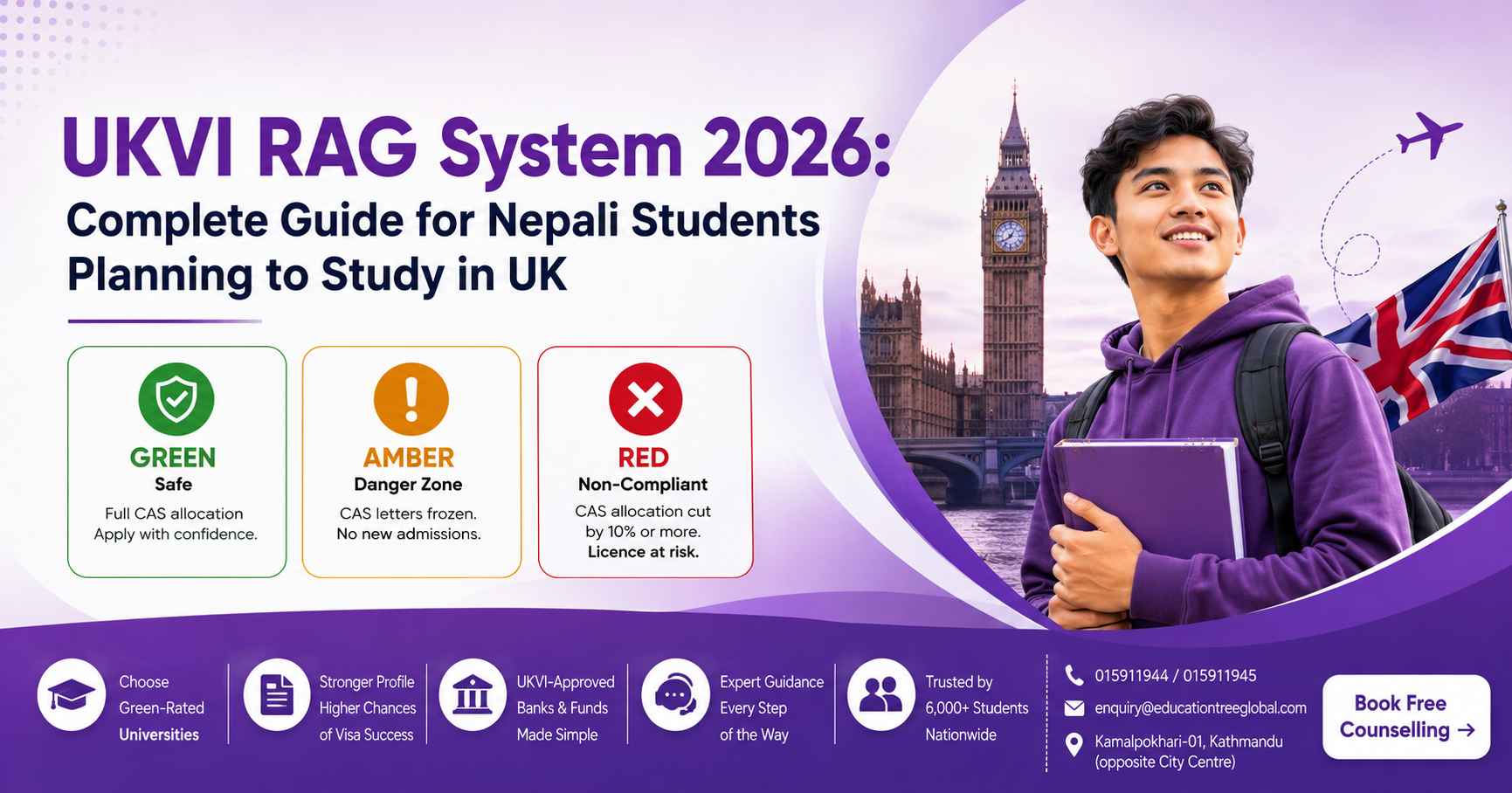
- Green Safe. The university meets all compliance thresholds. Full CAS allocation.
- Amber Danger zone. CAS letters completely frozen. No new international student admissions until resolved.
- Red Non-compliant. CAS allocation cut by a minimum of 10% (with no stated maximum). Licence revocation risk.
Every UK university holding a UKVI Student Sponsor Licence is assigned one of these three ratings. And the consequences for students at Amber or Red universities are severe — not the university’s problem alone.
The 3 Metrics That Decide Every UK University’s Rating in 2026
A university’s RAG band is not an average across metrics. It is determined entirely by its worst-performing metric. This is the single most important thing to understand about the new system.
A university could have an excellent visa refusal rate and strong enrolment numbers but if its course completion rate falls short, it receives the lower rating overall. One weak metric pulls the entire institution into Amber or Red.
The three metrics, and the thresholds from 2026, are:
| Metric | Green (safe) | Amber (danger) | Red (non-compliant) |
| Visa refusal rate | Below 4% | 4% – 4.99% | 5% or above |
| Student enrolment rate | Above 96% | 95% – 95.99% | Below 95% |
| Course completion rate | Above 92% | 90% – 91.99% | Below 90% |
Note: The course completion threshold rises further from 2027 under continued tightening.
For context, the old BCA framework allowed a visa refusal rate of up to 10% before triggering action, and enrolment only needed to reach 90%. Those thresholds have been halved and raised significantly. Universities that sailed through BCA assessments every year may now find themselves at Amber or Red under the new system.
Green, Amber and Red: What Each Band Means for Your CAS and Visa
Understanding the practical consequences of each rating is essential before you choose a UK university or accept an offer.
Green band what it means for you
A Green-rated university meets all three compliance thresholds. For you as a Nepali student, this means:
- Your CAS letter will be issued normally after you accept your offer and pay your deposit
- Your visa application is processed without heightened scrutiny from UKVI
- The university is not at risk of having its sponsor licence restricted or revoked
- You can proceed with confidence on your IELTS/PTE preparation, financial documentation, and application timeline
ETG only recommends universities operating in the Green band. This is a non-negotiable policy for our students.
Red band what it means for you
A Red-rated university has triggered the compliance floor on at least one metric. The consequences are immediate:
- UKVI places the university on an action plan
- CAS allocation is cut by a minimum of 10% with no ceiling on how much further it can be reduced
- The university loses trusted sponsor privileges, including the ability to self-assess English language levels
- A five-year final warning is issued a second Red rating within five assessment cycles triggers licence revocation entirely
- Any existing student whose university loses its licence can face visa curtailment
For you as a Nepali student, this means: even if you hold a valid offer letter from a Red-rated university, your CAS may not be issued. You may lose your tuition deposit. Your visa application if a CAS is issued at all faces heightened scrutiny.
Universities placed on UKVI action plans ahead of the formal RAG launch include the University of Essex and Glasgow Caledonian University (mid-2025) and the University of Central Lancashire (December 2024). These institutions may begin their RAG assessments already at a disadvantage.
The Amber Trap: Why a Frozen CAS is Worse Than a Cut
Here is the counterintuitive truth about the RAG system that most students do not realise: Amber can actually be worse than Red for a student who already holds an offer.
At Red, UKVI cuts CAS allocation which means some CAS letters can still be issued. The university is under pressure but can still function.
At Amber, CAS allocation is completely frozen. Not reduced. Frozen. Not a single new CAS letter can be issued to any international student regardless of their academic quality, financial standing, or how long they have been waiting until the university achieves a Green rating at its next annual assessment cycle.
For a student who has paid a tuition deposit, prepared IELTS scores, and arranged bank balance documentation, an Amber freeze means their entire application stops through no fault of their own, and with no clear timeline for resolution.
As Wonkhe described it: “Amber is not a buffer zone it is a ledge.”
The Vice-Chancellor or CEO of an Amber-rated university must personally attend a UKVI meeting within 30 days and submit a formal remediation plan. This is treated as a leadership failure, not an administrative matter.
Why Nepal is at the Centre of This Change: The Numbers
The UKVI RAG system 2026 is not a UK-wide policy change that happens to affect Nepal. Nepal is specifically and disproportionately at the centre of it.
Consider the data:
- Nepal is the 5th largest source country for UK student visas globally
- Over 20,600 sponsored study visas were issued to Nepali students in the most recent year a 63% year-on-year increase
- In 2025, 16% of UK visa applications from Nepal were refused up sharply from just 2% in 2024
That 16% refusal rate is critical context. A university’s visa refusal metric under the RAG system is measured at the institutional level but it is affected by the refusal rate of every nationality applying through that university. If a university has above-average refusal rates among its Nepali student cohort, it directly risks its Green band rating.
This creates a secondary effect: universities that are already close to the Amber threshold on refusal rates may begin quietly reducing Nepali admissions, or applying stricter filtering to Nepali applications, to protect their overall RAG rating even if individual Nepali applicants are fully qualified.
Additionally, Nepali students affected by January 2026 visa processing delays who missed enrolment deadlines through no fault of their own may have already depressed some universities’ first RAG enrolment figures. The consequences of that are still unfolding.
The bottom line is that the rapid growth of Nepali students going to the UK which should be celebrated has made the compliance relationship between Nepal-origin applications and UK university ratings more tightly coupled than for almost any other nationality.
Other UK Visa and Immigration Changes Nepali Students Must Know in 2026
The UKVI RAG system is the headline change, but it sits alongside several other active UK immigration rule changes that every Nepali applicant needs to understand before applying.
UK eVisa fully digital from 2026
From 25 February 2026, most successful UK visa applicants receive only a digital visa linked to their passport through a UKVI online account. There is no physical BRP card and no visa sticker. Losing access to your UKVI account can cause serious immigration complications you must maintain your login credentials carefully from the moment you apply.
Dependent restrictions still in effect
Since January 2024, most international students cannot bring dependants (spouse or children) to the UK under the Student Route. Only PhD students and government-funded scholars are exempt. This is a critical planning point for married Nepali students and those with children.
Graduate Route Visa use it before January 2027
The UK Graduate Route currently allows 2 years of post-graduation work in any job, at any salary, with no employer sponsorship required (3 years for PhD graduates). This is one of the biggest reasons Nepali students choose the UK over other destinations.
However, the Graduate Route duration is set to reduce from 2 years to 18 months for Bachelor’s and Master’s graduates from January 2027. Students who graduate and apply for the Graduate Route before 31 December 2026 still receive the full 2-year entitlement. If the Graduate Route is important to your plans, your intake timing matters significantly discuss this with an ETG counsellor.
Financial requirements in both £ and NPR
UKVI requires proof of funds maintained in a UKVI-approved Nepali bank for 28 consecutive days before your visa application:
- Outside London: £10,539 (~NPR 20.5 lakhs) plus your full first-year tuition fee
- London: £13,761 (~NPR 26.8 lakhs) plus your full first-year tuition fee
Only 12 specific Nepali banks are UKVI-approved. Any withdrawal that drops your balance below the threshold resets the 28-day count.
English language requirements for work visas tightened
In 2026, the minimum English language requirement for UK work visas (post-study) has been raised to B2 on the CEFR scale equivalent to approximately IELTS 5.5 to 6.5. This makes strong IELTS or PTE preparation before departure more important than ever.
How to Check If Your UK University is Green-Rated and What ETG Does for You
Here is an important reality that most students do not know: UKVI does not publish a public list of Green, Amber, or Red universities.
The RAG band system is internal to UKVI. Universities are informed of their own rating but are not required to disclose it to students or prospective applicants. You can accept an offer, pay a deposit, and prepare for months and never know that the university is Amber or Red until your CAS does not arrive.
This is where working with a registered study abroad consultancy in Nepal like Education Tree Global becomes not just convenient, but genuinely protective.
ETG’s UK counsellors actively monitor compliance data across our partner universities and maintain direct institutional relationships that give us early visibility of any compliance concerns. We never recommend a university to a Nepali student without verifying its RAG status first.
If you already have a UK university on your shortlist, contact ETG for a free RAG status check before you accept your offer or pay any deposit.
5-Step Checklist: What Every Nepali Student Must Do Right Now
Use this checklist whether you are applying for a 2026 intake or planning for 2027.
Step 1: Verify your university’s RAG status before accepting any offer Do not pay a tuition deposit to any UK university without confirming its Green band status. Contact ETG for a free check same working day.
Step 2: Prepare your IELTS or PTE score to a competitive level Meeting the minimum score is no longer enough. A stronger IELTS or PTE score gives both you and your university a buffer against the tighter visa refusal thresholds. ETG offers IELTS and PTE preparation classes in Kathmandu contact us to enrol.
Step 3: Arrange your bank balance early in a UKVI-approved bank Start building and maintaining the required amount (£10,539 outside London / ~NPR 20.5 lakhs or £13,761 London / ~NPR 26.8 lakhs) in one of the 12 UKVI-approved Nepali banks at least 60 days before your visa application to give yourself a buffer for the mandatory 28-day window.
Step 4: Prepare a strong SOP tailored to the 2026 UK visa environment The visa refusal rate for Nepali students jumped from 2% to 16% in one year. A weak or generic Statement of Purpose is one of the most common refusal triggers. ETG counsellors review and strengthen SOPs at no cost.
Step 5: Apply early do not wait September 2026 intake: aim to have your university offer and CAS by July 2026 at the latest. January 2027 intake: target October 2026 submission. Universities under RAG pressure impose earlier CAS deadlines than they previously did, and demand from students redirected away from Amber/Red universities is increasing at compliant institutions.
Frequently Asked Questions
What is the UKVI RAG system?
The UKVI RAG system is a Red-Amber-Green university compliance rating framework that replaced the old Basic Compliance Assessment (BCA) from 2026. Every UK university holding a Student Sponsor Licence is rated Green, Amber, or Red based on three metrics: visa refusal rate, student enrolment rate, and course completion rate. The rating is determined by the university’s worst-performing metric not an average. Green universities have full CAS allocation; Amber universities have CAS completely frozen; Red universities have CAS cut by a minimum of 10%.
How does the RAG system affect Nepali students?
Nepal is the UK’s 5th largest student source country with over 20,600 sponsored study visas annually and a 63% year-on-year growth rate. This makes Nepal-origin applications a significant component of many UK universities’ compliance calculations. A university with above-average refusal rates among Nepali applicants risks its Green band rating. If your university becomes Amber, your CAS is frozen and your visa application cannot proceed. If it becomes Red, your CAS may not be issued even after you have accepted your offer and paid a deposit.
What happens if a UK university gets a Red rating?
A Red-rated university is immediately placed on a UKVI action plan. Its CAS allocation is cut by a minimum of 10% with no cap on further cuts. It loses trusted sponsor privileges including English self-assessment rights. A five-year final warning is issued a second Red rating within five assessment cycles triggers the licence revocation process. For students at Red-rated universities: CAS letters become scarce even for fully qualified applicants, and visa applications face heightened scrutiny from UKVI.
How can I check if my UK university is Green-rated in 2026?
UKVI does not publish a public Green, Amber, or Red list. The ratings are internal. Universities know their own band but are not required to tell students. The only reliable way to check is through a consultancy with direct institutional relationships and compliance monitoring. Education Tree Global (ETG) checks the RAG status of any UK university on your shortlist free, same working day. Contact our Kathmandu office or book a free counselling session on our website.
Is my UK university safe if it passed the old BCA every year?
Not necessarily. The old BCA allowed a visa refusal rate of up to 10% and enrolment as low as 90%. The new Green band requires refusal below 4% and enrolment above 96% a dramatic tightening. A university with a historically comfortable BCA record may now find itself at Amber or Red under the new thresholds. Past BCA compliance is not a reliable indicator of current RAG status.
What is the Amber band CAS freeze and why is it dangerous?
An Amber band rating means UKVI completely freezes the university’s CAS allocation. Not reduces freezes entirely. Not a single new CAS letter can be issued to any international student until the university achieves Green at its next annual assessment. For a student with an offer letter, a paid deposit, and a visa application ready to submit, an Amber freeze means everything stops with no clear timeline for resolution. This is why ETG counsellors often describe Amber as more dangerous than Red for students with existing offers: at Red, some CAS letters can still be issued. At Amber, none can.
Study in UK from Nepal with ETG Your Next Step
The UKVI RAG system 2026 has raised the stakes for every Nepali student considering the UK. Choosing the wrong university is no longer just an academic or financial risk it can mean a frozen CAS, a lost deposit, and a visa application that never proceeds.
Education Tree Global is Nepal’s trusted study abroad consultancy with over 6,000 students successfully placed in Australia, UK, USA, Canada, New Zealand, and Ireland. Our Kathmandu counsellors are AAERI-registered, ICEF-certified, and QEAC-accredited and our UK visa guidance is provided entirely free of charge.
When you work with ETG for your UK application, we:
- Verify your university’s RAG compliance status before you accept any offer
- Prepare and review your full visa documentation
- Strengthen your SOP specifically for the 2026 UK visa environment
- Support your IELTS or PTE preparation through our Kathmandu classes
- Guide your bank balance preparation across UKVI-approved Nepali banks
- Provide pre-departure orientation once your visa is approved
Book your free counselling session today in-person at our Kamalpokhari office in Kathmandu, at our Sarlahi or Butwal branches, or virtually from anywhere in Nepal.
015911944 / 015911945 / 970-0044344
enquiry@educationtreeglobal.com
Kamalpokhari-01, Kathmandu (opposite City Centre)